 Amical
Shortcuts
The five global shortcuts Amical registers and how to rebind them.
Amical registers five global shortcuts. They all live under Settings → Shortcuts.
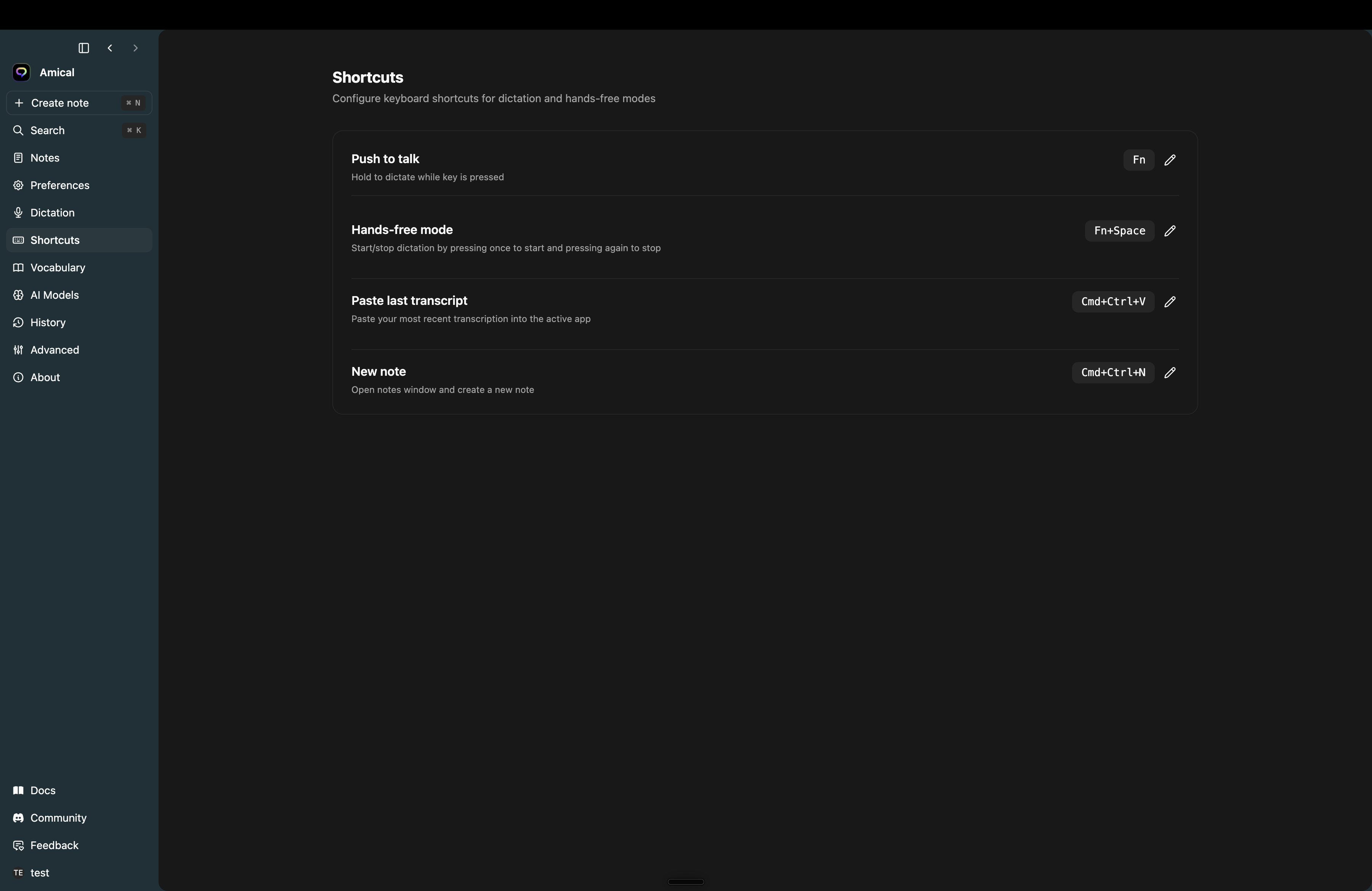
| Shortcut | Default | What it does |
|---|---|---|
| Push to talk | Fn | Hold to record, release to transcribe and paste. |
| Hands-free mode | Fn+Space | Press once to start a recording, again to stop. |
| Paste last transcript | Cmd+Ctrl+V | Re-pastes the most recent transcription into the focused app. |
| New note | Cmd+Ctrl+N | Opens a fresh note in Amical. |
| Draft (Alpha) | Fn+Ctrl | Hold to speak an instruction; review the generated text, then insert it. Amical Cloud only. |
When to use which dictation shortcut
- Push to talk is best for short bursts — a quick reply, a search query, a one-liner. Releasing the key always stops the recording, so it can't run away on you.
- Hands-free mode is best for longer passages — drafting an email, talking through a thought, code comments. Clicking the floating widget triggers the same mode without touching the keyboard.
Both modes share the same silence-detection, length cap, and slip-press threshold — see AI dictation for the exact numbers.
Rebind one
- Open Settings → Shortcuts.
- Click the chip for the shortcut you want to change.
- Press the keys. Amical captures the combination live.
If the combination conflicts with something else (a system shortcut, an already-bound Amical shortcut), Amical reverts the change and shows the conflict in a toast.
Allow injected keystrokes (Windows)
Amical only responds to physical key presses. Some Windows setups send keystrokes another way — they inject them: remote desktop sessions, KVM switches, key remappers like PowerToys, and mouse or macro software that fires a key combo from a button. By default Amical ignores injected keys, so a background tool can't set off your shortcuts by accident.
Turn on Allow injected keystrokes (under Settings → Shortcuts) when you want those keys to count — for example, you've bound an Amical shortcut to a mouse-based macro or a macro key, or your keyboard reaches Amical through remote desktop or a KVM and your shortcuts otherwise never fire. Injected keys then count the same as physical ones.
Turning this on has trade-offs
Once injected keys are allowed, a tool sending keys in the background can interfere with your shortcuts:
- Setting a shortcut — the recorder can pick up an injected key you didn't press.
- Triggering a shortcut — a shortcut can fire on its own, from a tool rather than from you.
- Dictation — a recording can stop unexpectedly when an injected key trips your Hands-free or Push-to-talk shortcut.
If your shortcuts start behaving unexpectedly, turn Allow injected keystrokes back off, so Amical again reacts only to keys you physically press.
Notes
- Shortcuts are global — they fire while any app has focus.
- Amical syncs them with a native helper to suppress the default behaviour of those keys, so a shortcut bound to Fn won't trigger the macOS dictation popup.
- If a key gets stuck (held when the app didn't see the release), Amical clears stale state every 10 seconds.