You saw the headline: Cohere Transcribe launched at #1 on the Open ASR Leaderboard on March 26, 2026, and now you're wondering whether to swap Parakeet for it. Here's the short answer to Cohere Transcribe vs Parakeet. Cohere Transcribe makes fewer errors on the leaderboard's English tests, and Parakeet v3 is several times faster. Neither one streams out of the box: Cohere's card describes batch transcription only, and Parakeet v3 is built for finished audio too.
This guide is for you if you write all day by voice and want the most accurate model for it. With push-to-talk (hold a key, talk, let go), the batch point matters more than the accuracy gap: what you feel is how fast the whole clip comes back as text, and whether that text is ready for the app you're in.
Every figure here is tied to its source: a model card, the Open ASR Leaderboard, a paper, or a vendor, and figures that can change are dated. We haven't run our own dictation test of Cohere Transcribe or Parakeet yet, so you won't find first-hand timings for either model here.
A note on who's writing: Amical publishes this blog, and we recommend it below. In local mode, Amical runs Whisper (OpenAI's open speech model) and Parakeet TDT 0.6B v3 on Mac and Windows; it doesn't run Cohere Transcribe. With Amical Cloud, its own speech model, Amical's stated figure is under 300 ms for a short dictation and under 500 ms for a longer one. Short and longer are Amical's own labels, and there's no public benchmark yet, so don't set that figure beside the model numbers below. Then AI formatting rewrites your words for the app you're in, so you get an email in Gmail, not a transcript.
The short answer
Cohere Transcribe is more accurate than Parakeet v3 on today's leaderboard, by a small margin. Parakeet v3 is far faster in batched tests, and it detects your language by itself. Cohere's card describes batch transcription only, with no streaming mode, and Parakeet v3 is built for finished audio too, so for a short dictation both hand you the text after you let go of the key.
| Cohere Transcribe | Parakeet TDT 0.6B v3 | |
|---|---|---|
| Maker, release | Cohere, March 26, 2026 | NVIDIA, August 14, 2025 |
| Size | 2B parameters | 600M parameters |
| License | Apache 2.0 | CC-BY-4.0 |
| Weights | Gated: log in to Hugging Face and agree to share your info | Open download |
| Languages | 14 | 25 European |
| Detects the language itself | No, you set it per clip | Yes |
| Live English WER, read 2026-10-25 (lower is better) | 5.77%, rank 12 | 6.18%, rank 29 |
| RTFx, batched on H200 GPUs (higher is faster) | 902.46 | 6,132.34 |
| Streaming | Batch only; the card describes no streaming mode | Offline-first; the Unified variant streams in English |
| Examples of dictation apps that run it locally | Superwhisper, Spokenly, OpenWhispr | Amical (v3, Mac and Windows), Handy (v3), Superwhisper, Spokenly |
Our pick for dictation is Amical: Amical Cloud for speed and 100+ languages, or local mode with Parakeet v3 or Whisper when you want to work offline. Pick Cohere Transcribe for accuracy-first transcription of recorded files, when you can wait for the whole file to finish.
Accuracy: Cohere leads, by less than the headline
Word error rate (WER) is the share of words a model gets wrong, so lower is better. The Open ASR Leaderboard, Hugging Face's public ranking of speech-to-text models, averages it across a set of English tests.
At launch, Cohere reported a 5.42% average WER and the #1 spot, ahead of Zoom Scribe v1 at 5.47% and Whisper Large v3 at 7.44% (as of March 26, 2026).
The board looks different now. On the live English table (read 2026-10-25), Cohere Transcribe sits at rank 12 of 57 with 5.77%, and Parakeet v3 is at rank 29 with 6.18%. The rows above Cohere without a speed figure are API models; of the models that do publish one, two are now ahead of Cohere: Qwen3-ASR 1.7B at 5.40% and Granite Speech 5.0 2B at 5.68%. We compare Qwen3-ASR with Whisper in Qwen3-ASR vs Whisper, and our best speech recognition models of 2026 roundup covers the wider field.
Ranks move, so check the live table before you quote any of these.
Don't read 5.42% against 5.77% as Cohere getting worse. The leaderboard changed its tests after launch: it removed Tedlium on May 20, 2026, switched to cleaned test splits in July, and added URGENT24 to the English average in October. So a score you saw in March and one you see today come from different exams.
So compare the two models within one table. On today's table, the gap between Cohere and Parakeet v3 is 0.41 points. On the leaderboard's test sets, that's about four more errors per thousand words for Parakeet v3, by our arithmetic. It's an average over those tests, not a forecast for your own dictation.
Cohere's accuracy comes from its design: a 2B-parameter Conformer model (a design built for speech) that puts over 90% of its parameters in the encoder, the part that listens.
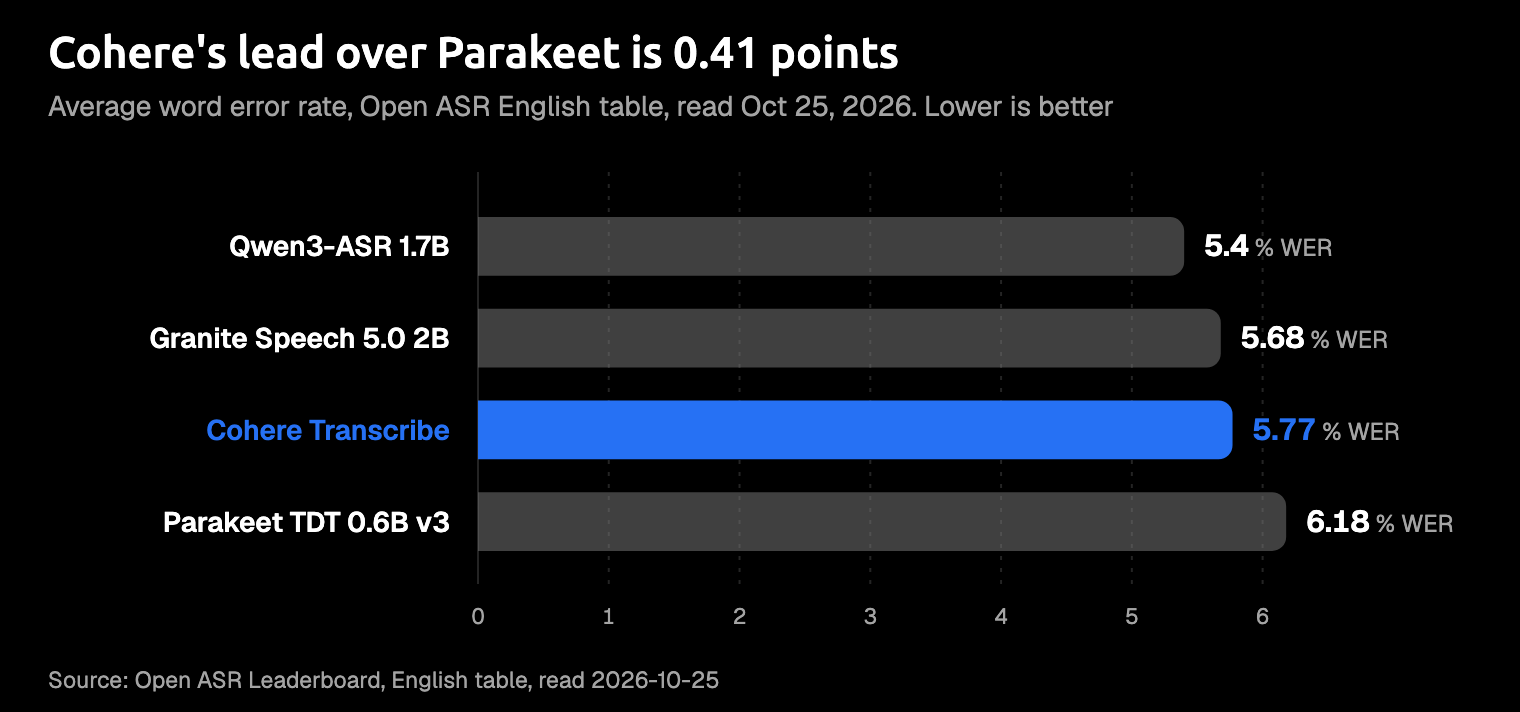
Average English WER on the live Open ASR Leaderboard, read 2026-10-25. Lower is better, and ranks move.
Speed: Parakeet is built for throughput
RTFx tells you how many seconds of audio a model gets through per second of compute, with many files processed in one batch. Higher is faster.
On the live table, Cohere Transcribe scores an RTFx of 902.46 and Parakeet v3 scores 6,132.34, measured on H200 data-center GPUs. That makes Parakeet about 6.8x faster at batched work, a ratio we worked out from those two figures. A second v3 entry on the board, run with the fast-gpu-asr decoder setting, reaches an RTFx of 14,125.69 at 6.08% WER (rank 26).
That pattern isn't a surprise. The paper behind the Open ASR Leaderboard found that Conformer encoders paired with Transformer decoders give the best accuracy, while faster decoder types, like the one in Parakeet, give much higher RTFx.
Cohere's encoder-decoder design sits on the accuracy side of that split, and Parakeet sits on the speed side.
Here's the catch: RTFx is batched server throughput, not how long one dictation takes on your laptop. We haven't found an independent single-clip timing for either model, so you can't read your own wait off these numbers.
Your laptop isn't a rack of H200s.
Size matters on your own machine, too. Cohere has 2B parameters against Parakeet v3's 600M. For Cohere, the smallest GGUF build (GGUF is a compact file format for running models locally) is a 1.56 GB download, as of 2026-10-25. For Parakeet v3, NVIDIA's card gives a memory need instead: at least 2 GB of RAM to load. We didn't find a download size on that card, so those two numbers measure different things, and you can't compare them.
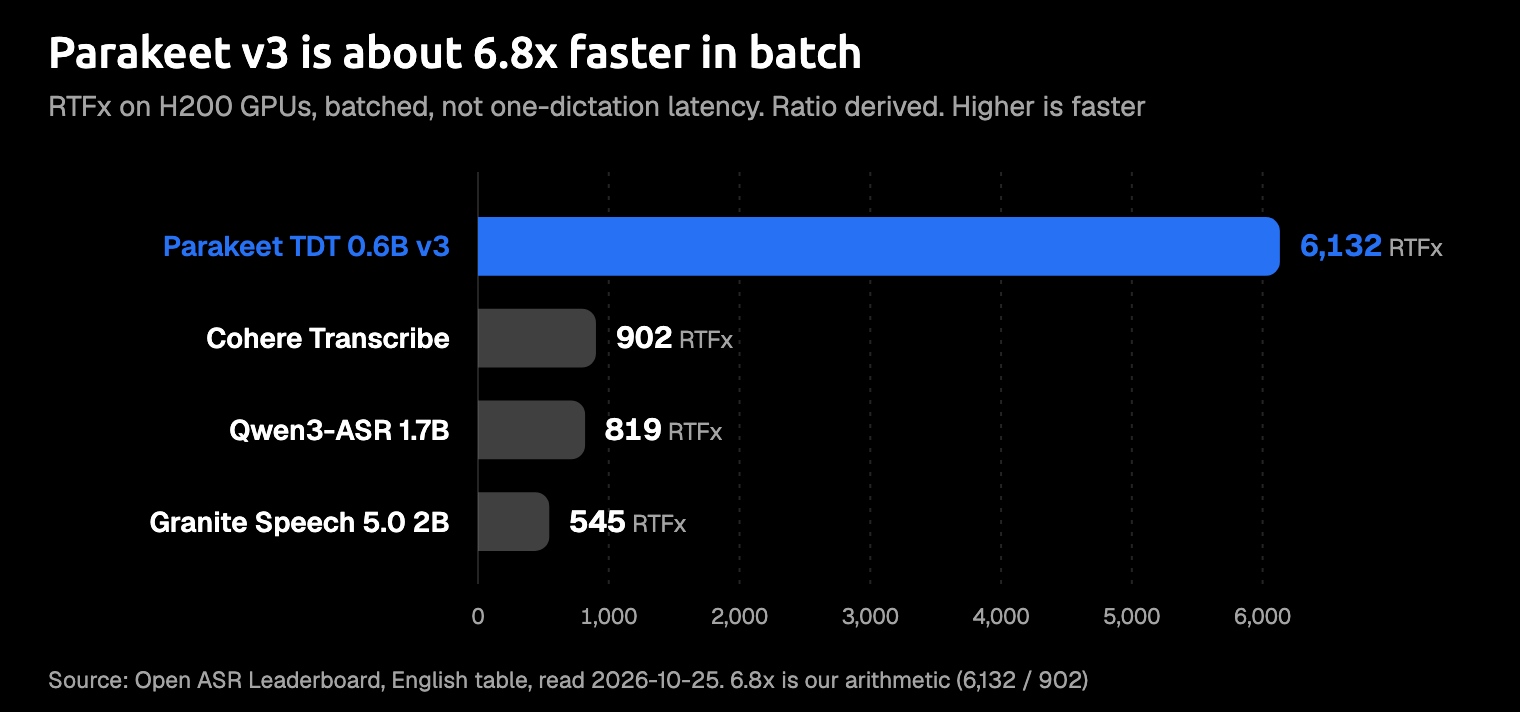
RTFx is batched throughput on H200 GPUs, not the wait for one dictation on your laptop. Live Open ASR Leaderboard English table, read 2026-10-25.
Why batch-only matters for dictation
A batch model transcribes a finished recording. A streaming model transcribes while the audio is still coming in, a small chunk at a time.
Cohere's model card describes offline transcription only: you give it audio files, and there's no streaming mode. You can serve it online through vLLM, but each request is still a finished clip.
Here's what that means when you dictate. With push-to-talk, a batch model starts work when you let go of the key, so you wait for the whole clip to decode. A streaming model works while you're talking, so only the last chunk is left when you stop.
Streaming models such as NVIDIA's Nemotron are built for that: they turn your speech into text while you're still talking. Our Nemotron streaming guide covers them in more depth.
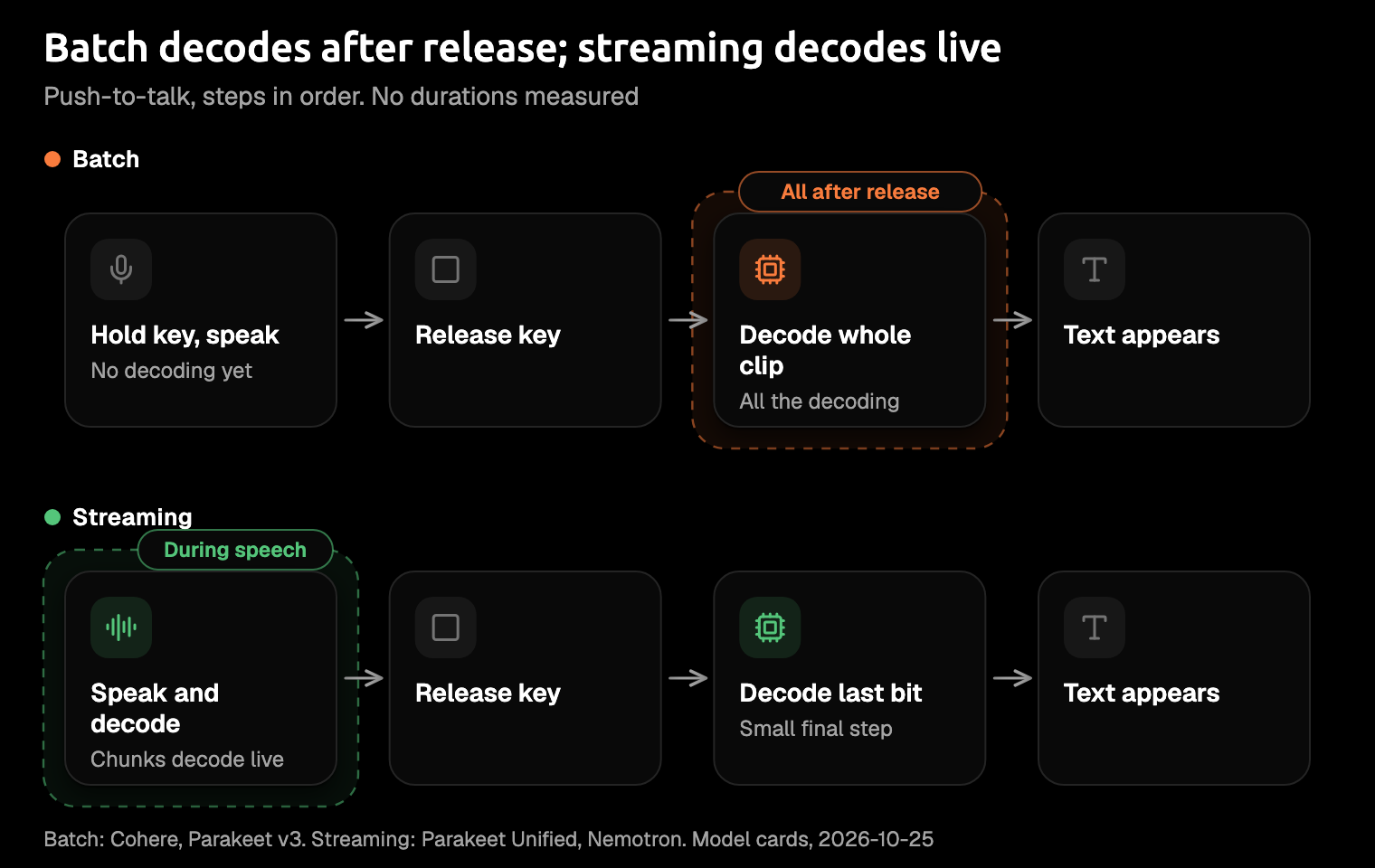
With a batch model, all the decoding waits until you let go of the key. With a streaming model, only the last chunk is left. No durations are shown, because none were measured.
Parakeet v3 is offline-first too; streaming it takes extra setup in NVIDIA's toolkit. The family's streaming option is Parakeet Unified, which is English only. Its own card shows the cost of streaming: average WER is 5.91% offline, 6.29% at 1.12 s of latency, and 8.44% at 0.16 s. Those numbers come from NVIDIA's card, and the live leaderboard doesn't list Unified, so don't set them beside the leaderboard figures above. Parakeet Unified vs v3 compares the two.
So for a short dictation, Cohere and Parakeet v3 both behave like batch models: you wait for the whole clip after you let go.
We haven't found an independent measurement of how long that decode takes for one push-to-talk clip on a laptop, for either model.
The real question, then, is how fast your finished text arrives, and how much work it still needs.
For dictation, that's the job Amical Cloud is built for. It's Amical's own speech model, designed for low latency, and its stated speed figure is the one in the intro. That figure isn't measured on the same basis as anything else in this post, so read it as Amical's figure, not a head-to-head result. AI formatting then writes the message for the app you're in: a proper email in Gmail, a loose reply in Slack, clean notes in your notes app. AI dictation explains push-to-talk and hands-free mode.
Languages: where Cohere covers what Parakeet doesn't
Cohere Transcribe supports 14 languages, and Parakeet v3 supports 25 European ones. They share nine: English, French, German, Italian, Spanish, Portuguese, Greek, Dutch, and Polish.
- Cohere only: Chinese (Mandarin), Japanese, Korean, Vietnamese, and Arabic.
- Parakeet v3 only: 16 more European languages, including Russian, Ukrainian, Czech, and Swedish.
They also differ in how you pick a language. Parakeet v3 detects the language for you. Cohere needs you to set the language for each clip, and its card says it handles code-switching (mixing languages in one sentence) inconsistently.
If you dictate in Japanese, Cohere is the only one of the two that covers it, because Parakeet v3 has no Chinese, Japanese, or Korean. But if you mix Japanese and English in one sentence, a single language tag per clip gets in your way.
Amical covers both cases. Amical Cloud handles 100+ languages and Japanese and English mixed in one sentence, and local mode with Whisper covers 99. For Japanese in local mode, choose Whisper, because Parakeet v3 doesn't cover it. Multi-language support shows how to set your languages.
How to try Cohere Transcribe today
If you'd like to run it yourself, here are your options, easiest first:
- Use a dictation app. Users asked for it on Superwhisper's feature board in April, and Superwhisper added it as a local, offline model in July 2026, a 1.3 GB download. Its blog doesn't say which plan includes it. Spokenly runs a Q4 build on Apple Silicon Macs (macOS 15+) and iPhones (iOS 18+), and OpenWhispr lists it among its local models (both as of 2026-10-25). Here's how Amical compares with Superwhisper.
- Get the weights. They're gated, which means you log in to Hugging Face (the site that hosts the model files) and agree to share your account info; approval is automatic. The license is Apache 2.0.
- Run it with Python. It needs
transformers5.4.0 or later, or you can serve it with vLLM (vllm==0.19.0), a serving tool that gives you an OpenAI-style transcription endpoint on a GPU server. - Run it on Apple Silicon. The mlx-speech library runs an int8 build (4.13 GB) on M1 or later Macs with Python 3.13+. The transcribe.cpp runtime has GGUF builds from 1.56 GB (
Q4_K_M) to 4.11 GB (BF16), as of 2026-10-25. - Call Cohere's API. Files are capped at 25 MB, there's a free rate-limited tier, and Cohere doesn't publish a price for production use (as of 2026-10-25).
- Add a noise gate. The model card warns that it can "transcribe" sounds that aren't speech, so put voice detection or a noise gate in front of it. It also gives you no timestamps or speaker labels.
Which should you use?
Our pick for dictation is Amical. Start with Amical Cloud: it's the fast option (its stated figure is in the intro), it covers 100+ languages, and AI formatting writes your words for each app. Switch to local mode with Parakeet v3 or Whisper when you're offline, or when you want your audio to stay on your computer. Cloud AI models and Local AI models explain each side, and cloud vs local dictation helps you weigh the trade-off.
Here are Amical's limits, in plain terms. Amical Cloud needs sign-in and isn't open source, and with it your audio and some context for formatting go to Amical; local mode on desktop needs no account. Local transcription on a Mac needs macOS 15 or later and is slower on Intel Macs, while Amical Cloud has neither limit. Amical doesn't run on Linux; if you're on Linux, Handy and OpenWhispr are open source dictation apps with Linux builds.
Amical Cloud is also what the iPhone, iPad, and Android apps use, so the same dictation goes with you to your phone (with sign-in).
Amical doesn't run Cohere Transcribe. If you want that exact model in a dictation app today, Superwhisper runs it locally, and Spokenly runs it on Apple Silicon Macs and iPhones.
Here's where each model fits:
- Cohere Transcribe: accuracy-first transcription of recorded files, or a local model for Chinese, Japanese, Korean, Vietnamese, or Arabic, when you have a GPU or an Apple Silicon Mac and can wait for the whole file.
- Parakeet v3: high-throughput local transcription in European languages, with automatic language detection; our Parakeet v3 guide covers it in full.
- Parakeet Unified: English dictation where you want text to appear while you're still talking; see Parakeet Unified vs v3.
- Comparing more models: our best speech recognition models of 2026 roundup sets these models beside the rest, and Parakeet vs Whisper compares the two you can run locally in Amical.
FAQ
Is Cohere Transcribe open source?
Its weights are released under Apache 2.0, but they're gated: you log in to Hugging Face and agree to share your info before you can download them.
Does Cohere Transcribe support streaming?
No. Its model card describes batch transcription of finished audio only, so in push-to-talk dictation it starts working when you release the key.
Can I run Cohere Transcribe on a Mac?
Yes, on Apple Silicon. You can use mlx-speech (M1 or later), a transcribe.cpp GGUF build, or a dictation app: Superwhisper and Spokenly both run it locally.
Is Cohere Transcribe more accurate than Parakeet?
On the live English table (read 2026-10-25), yes: 5.77% average WER against 6.18% for Parakeet v3, a gap of 0.41 points. Scores and ranks move, so check the live board.
Try it on your own voice
The leaderboard tells you which model makes fewer errors on its test sets. For dictation, what counts is how your own voice comes out, in the app you're actually writing in.
Amical publishes this blog, so weigh our advice with that in mind: download Amical and dictate one real email or prompt with Amical Cloud, one you'd otherwise type today. The free plan includes unlimited local dictation plus 2,000 Amical Cloud words a week, and pricing has the details. To compare, the desktop quick start shows you how to switch to local mode and dictate the same email with Parakeet v3 or Whisper.