You open the speech model list in your dictation app, and two names sit side by side: Parakeet v3 from NVIDIA and Whisper Large v3 Turbo from OpenAI. Neither name tells you which one to pick for the emails and Slack replies you dictate every day.
If you dictate in English, Parakeet v3 is the pick: it's slightly more accurate on public English benchmarks, and much faster on the leaderboard's speed test. For the rest of Parakeet's 25 European languages, start with Parakeet but try both, because there's no published Turbo score to compare against. If your language isn't on Parakeet's list, pick Whisper Large v3 Turbo, which covers 99 languages.
One catch matters when you dictate, because you pause. Whisper is documented to invent text during silence, and we found no published test of Parakeet either way.
This guide is for you if you run speech models on your own computer, for privacy or for offline work. Whisper and Parakeet are both open speech-to-text models: you download them once, and they turn your voice into text on your own machine. We haven't run our own same-machine test yet. Model facts here come from NVIDIA, OpenAI, the Open ASR Leaderboard paper (a public benchmark for speech recognition models), published research and open source project pages, and facts about Amical come from Amical.
A note on who's writing: Amical publishes this blog, and it runs both models. In local mode, Amical runs Parakeet TDT 0.6B v3 and Whisper Large v3 Turbo on Mac and Windows, offline once downloaded and with no account. Whisper runs through whisper.cpp, a version of Whisper built to run fast on ordinary computers. Whichever you pick, Amical's AI formatting then writes what you meant for the app you're in, like a proper email in Gmail or a short reply in Slack.
The short answer
For English dictation, Parakeet v3 leads on both accuracy and speed, and the table shows by how much.
| Parakeet v3 | Whisper Large v3 Turbo | |
|---|---|---|
| Maker | NVIDIA | OpenAI |
| Parameters | 600M | 809M |
| License | CC-BY-4.0 | MIT |
| Languages | 25 European, auto-detected | 99 |
| Short-form English WER (Open ASR Leaderboard) | 6.32% | 7.83% |
| Long-form English WER (Open ASR Leaderboard) | 10.7% | 11.0% |
| Speed, RTFx (A100 GPU, batch size 64) | 3,330 | 200 |
| Released | August 2025 | October 2024 |
| Word-level timestamps | Yes | Yes |
| Official runtime | NeMo on NVIDIA GPUs under Linux; the card also lists a C++ runtime and Transformers | OpenAI's whisper package; whisper.cpp runs it on Mac, Windows and more |
| Local in Amical | Mac and Windows | Mac and Windows |
| Weights in the maker's repo | about 2.5 GB, stored in 32-bit (F32) | about 1.6 GB, stored in 16-bit (F16) |
| Download in Amical | not published | about 1.5 GB |
RTFx is throughput on a data-center GPU, not the wait you'll feel on a laptop. The speed section explains why, and the size section explains why the smaller model has the bigger file.
Two different designs
Parakeet TDT 0.6B v3 is NVIDIA's model. It uses a fast decoder design called TDT (token-and-duration transducer), and one model covers 25 European languages. Whisper Large v3 Turbo is OpenAI's Large v3 with a much smaller decoder, the part that writes the text. OpenAI cut that decoder from 32 layers to 4. Turbo covers 99 languages.
The Open ASR Leaderboard paper found that models with a TDT decoder, like Parakeet, run much faster than models with a transformer decoder, like Whisper's, at a small cost in accuracy against those models. In the English tables below, Parakeet doesn't pay that cost against Turbo. The paper also found that covering more languages costs some English accuracy. For your dictation, that's the trade in one line: Parakeet is built for speed in fewer languages, and Whisper for reach across many.
If you want the detail, this series has a post on Parakeet TDT v3 and one comparing Whisper Large v3 Turbo with Large v3.
Accuracy in English
Word error rate (WER) is the share of your words a model gets wrong, written as a percentage, so lower is better.
On the leaderboard's short English clips, Parakeet v3 averages 6.32% and Whisper Large v3 Turbo averages 7.83%, about one and a half points apart. Those averages come from the leaderboard paper, with figures as of 27 March 2026.
Dataset by dataset, using each model card's leaderboard results, Parakeet comes out ahead on seven of the eight test sets. The gap is widest on meeting recordings (AMI, 11.39% against 16.13%) and on European Parliament speeches (VoxPopuli, 6.09% against 11.87%). Turbo wins one set, SPGISpeech, which is recorded financial calls: 2.97% against 3.98%.
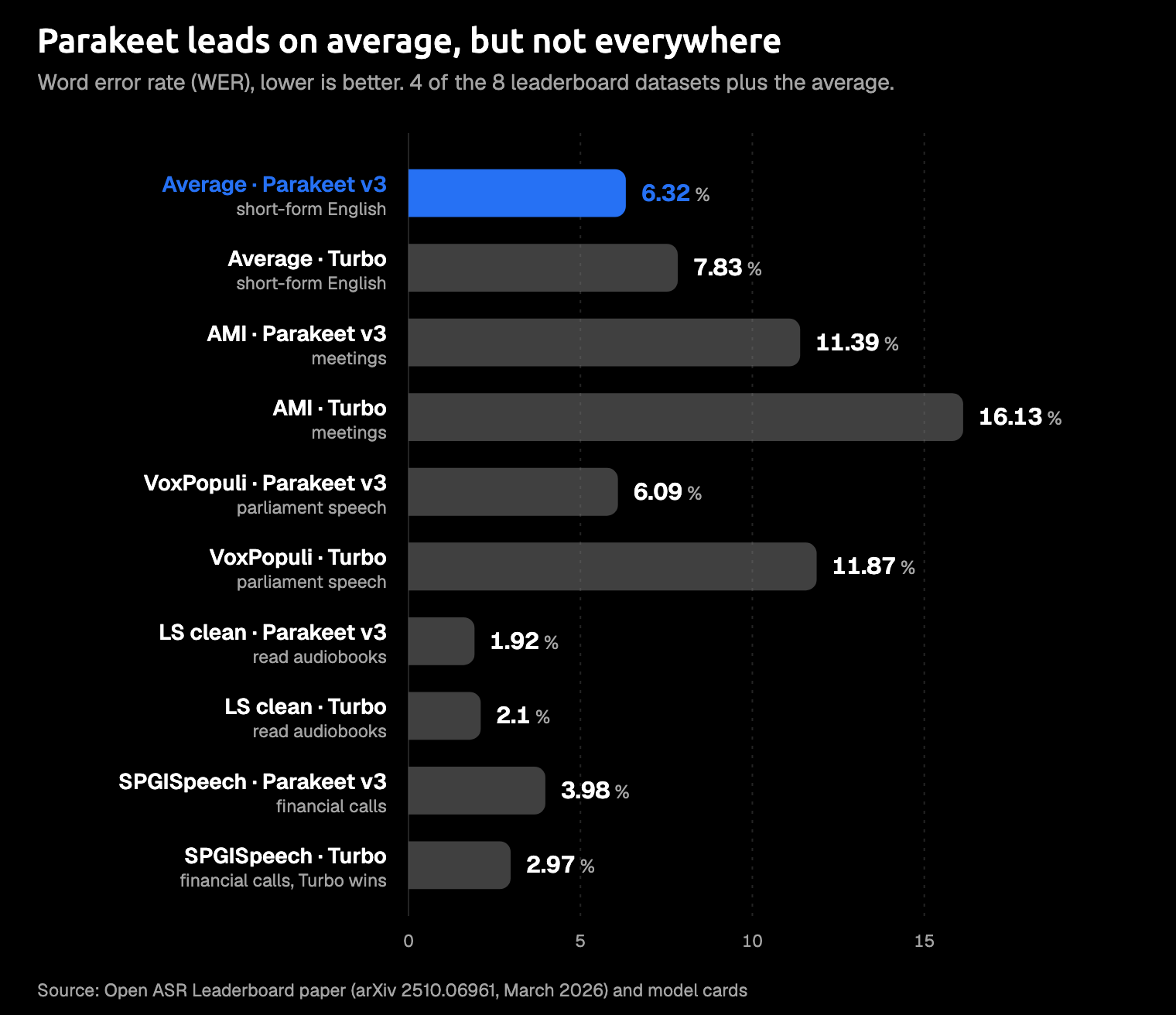
Lower is better. Turbo = Whisper Large v3 Turbo. The chart shows four of the eight English test sets plus the average; Parakeet also leads on the other four (Earnings-22, GigaSpeech, LibriSpeech other and TED-LIUM). Per-dataset WER from each model card's leaderboard results; averages from the Open ASR Leaderboard paper (March 2026).
On long recordings, the gap almost closes: 10.7% for Parakeet against 11.0% for Turbo, three tenths of a point.
So which numbers fit dictation? Short clips, one speaker, and a microphone close to your mouth make the short-form set the closer match. But none of these test sets is dictation, so read them as a guide, not a promise about your voice.
Background noise is the other thing you'll run into, in a coffee shop or an open-plan office. Parakeet's card shows its average WER rising to 11.66% when the noise is as loud as the speech. We found no matching figure from OpenAI for Turbo, so there's no fair head-to-head on noise.
Speed
RTFx tells you how many seconds of audio a model transcribes in one second, so higher is faster.
On the leaderboard, Parakeet v3 scores 3,330 on short clips against 200 for Turbo, and 1,000 against 148 on long recordings. By our own arithmetic, that's roughly seventeen times the throughput on short clips (3,330 divided by 200).
There's a catch, though. Those runs used an NVIDIA A100, a data-center GPU, at batch size 64, and the paper itself says absolute RTFx may not transfer to other hardware. Your laptop isn't an A100, and you dictate one clip at a time.
For push-to-talk dictation, the number you feel is the wait between letting go of the key and seeing your text. Whisper's card says it can't be used for real-time transcription out of the box. We don't have a speed figure for either model in Amical's local mode, so we won't guess one.
So speed alone won't decide this pick. Accuracy and your language will.
Languages: 25 vs 99
Parakeet v3 covers 25 European languages: Bulgarian, Croatian, Czech, Danish, Dutch, English, Estonian, Finnish, French, German, Greek, Hungarian, Italian, Latvian, Lithuanian, Maltese, Polish, Portuguese, Romanian, Russian, Slovak, Slovenian, Spanish, Swedish, and Ukrainian. It detects which one you're speaking without any setting. There's no Japanese, Chinese, Korean, Arabic, or Hindi.
Being on the list doesn't make every language equally good. On FLEURS, a multilingual test set, Parakeet's card shows WER from 3.00% in Italian to 24.03% in Slovenian. If you dictate in Slovenian or Latvian, test it on your own voice before you rely on it.
Whisper Large v3 Turbo covers 99 languages, per its model card. That coverage is uneven: OpenAI says Turbo is close to Large v2 overall but drops more in some languages, such as Thai and Cantonese. Turbo also wasn't trained for translation, which doesn't affect dictation, where the model just writes down what you said.
You may see a tie quoted between the two. On the leaderboard's multilingual track (German, French, Italian, Spanish, and Portuguese), Parakeet ties Whisper Large v3 at 4.81% average WER. That's the full Large v3, not Turbo, and the paper has no Turbo row in its multilingual table, so there's no direct multilingual score for these two.
So if your language is on Parakeet's list but isn't English, the numbers can't settle it. Try both on your own voice before you settle on one.
In Amical's local mode, you get Whisper's 99 languages plus auto-detect, and Multi-language support explains how to set yours.
Silence, pauses and invented text
Dictation has pauses. You stop to think, you reread the message you're replying to, you reach for your coffee.
What a model does in those gaps isn't something the benchmarks above measure.
Whisper's habit of writing words nobody said is well documented. Its own model card warns that it may output text that wasn't actually spoken, and that it can repeat itself. The Careless Whisper study (2024) tested an earlier version of OpenAI's Whisper service, not Turbo, on recordings of people with aphasia and a control group. About 1% of transcripts contained whole invented phrases, and they were more common for speakers with longer pauses. That isn't a measured rate for Turbo on your everyday dictation, but the same pattern is plausible.
A study presented at ICASSP 2025 found that non-speech audio sets off a recurring set of invented phrases. And whisper.cpp has had an open issue called "Hallucination on silence" since January 2024, still open as of October 2026. It supports VAD (voice activity detection), which cuts silence out before the model hears it. Users in OpenAI's own Whisper discussions report several other fixes, and no single one works everywhere.
For Parakeet, the evidence is thin. Its model card says nothing about silence, only that transcripts may not be 100% accurate, and we found no independent test.
So Whisper is documented to do this, and for Parakeet we found no published test either way.
In Amical, a recording stops on its own after 5 seconds of silence. That keeps long silent stretches out of your clip, but it isn't a fix in the model, so read your text once before you send it.
Your hardware: Apple Silicon, Intel Mac, Windows
Whisper runs almost anywhere, thanks to whisper.cpp: Apple Silicon Macs, Intel Macs, Windows PCs, and NVIDIA or Vulkan-capable graphics cards. On Apple Silicon it can use Metal (Apple's graphics acceleration) and Core ML, Apple's way of running models on the Neural Engine. The README says running the encoder through Core ML is "more than x3 faster" than the CPU alone.
Parakeet's official home is narrower. Its model card's listed path is NVIDIA's NeMo toolkit on NVIDIA GPUs under Linux, and the card also lists a lightweight C++ runtime and Hugging Face's Transformers library. Community projects such as parakeet-mlx and sherpa-onnx run Parakeet on other hardware: parakeet-mlx on Apple Silicon, and sherpa-onnx on an ordinary CPU, with a Windows build.
In Amical, both models run locally on Mac (macOS 15 or later) and Windows. On Intel Macs, local mode runs without Metal and is slower. If you're on an Intel Mac, you can still run Whisper Large v3 Turbo locally, or use Amical Cloud.
If you're on Linux, Amical has no build for you. In our view, NVIDIA's NeMo route, which the card targets at Linux, is the closest fit for Parakeet there.
Size, license and the rest
Parakeet v3 has 600M parameters (the values a model learns in training), and Turbo has 809M. Yet Parakeet has the bigger files. NVIDIA stores Parakeet's weights as 32-bit numbers, about 2.5 GB, while OpenAI stores Turbo's as 16-bit numbers, about 1.6 GB. NVIDIA also offers a 714 MB 8-bit build for its C++ runtime.
Amical's downloads are separate builds. In Amical, Turbo is about a 1.5 GB download, and Amical doesn't list a size for its Parakeet download.
Parakeet uses the CC-BY-4.0 license, which allows commercial use but asks for attribution, and Whisper is MIT, which only matters if you build something with them.
Parakeet's card says it writes text with punctuation and capitalization. In Amical, the transcript is only the first step with either model: AI formatting rewrites it for the app you're in.
Our pick
Our pick for English dictation is Parakeet v3. The full decision:
- English, on an Apple Silicon Mac (macOS 15 or later) or a Windows PC: Parakeet v3. It's about one and a half points lower in WER on short English clips and faster on the leaderboard's speed test.
- Another of Parakeet's 25 languages: try Parakeet v3 and Turbo on the same paragraph, since there's no Turbo score for those languages.
- A language outside the 25: Whisper Large v3 Turbo in local mode, for 99 languages, or Amical Cloud, for 100+.
- An Intel Mac: Whisper Large v3 Turbo still runs in local mode, only slower without Metal, or use Amical Cloud.
- Japanese mixed with English in one dictation: Amical Cloud, which handles both languages in one sentence. Local Whisper handles one language at a time, so it isn't the pick for mixing.
- You'd rather not choose: Amical Cloud. Amical says it's the fastest dictation in the category: finished, formatted text in under 300 ms for short dictations and under 500 ms for longer ones, though there's no public benchmark yet.
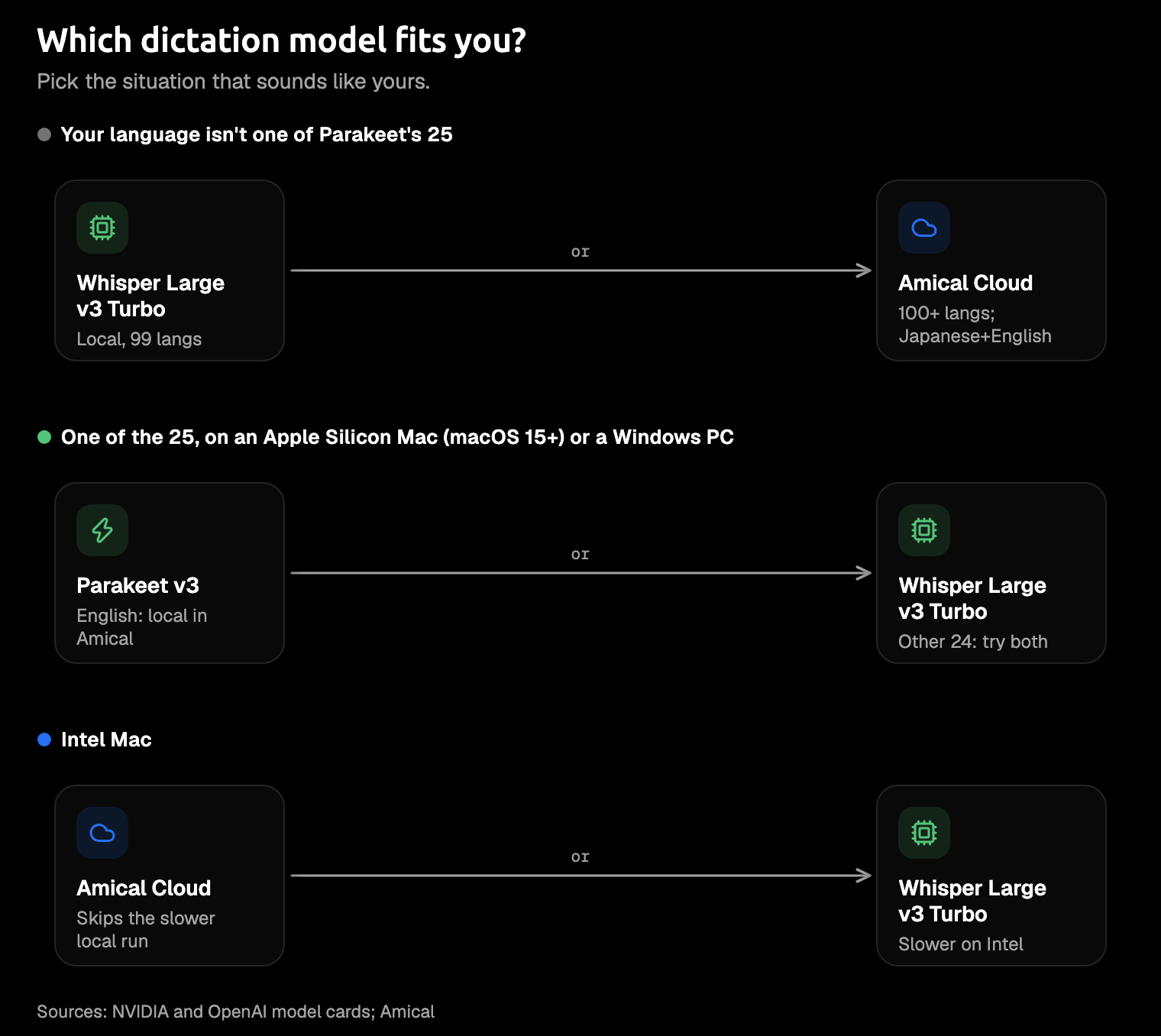
Find the situation that sounds like yours. For Parakeet's other 24 languages, try both models on your own voice.
What Amical adds on top
Whichever model you pick, the transcript isn't the finish line. AI formatting runs on top of either one and writes what you meant: a proper email in Gmail, a loose reply in Slack, a clean prompt in Cursor. Custom vocabulary works with Parakeet, for your names and jargon. If you point formatting at a local model through Ollama (a tool that runs AI models on your own computer), your text stays local too; a cloud AI provider would receive it.
Say this into Slack, for example (an illustration, not a measured result):
um so can we push the sync to thursday, like after lunch, and I'll bring the numbers
Amical writes:
Can we push the sync to Thursday after lunch? I'll bring the numbers.
Amical Cloud is also what Amical's iPhone, iPad, and Android apps use, so your dictation follows you to your phone. It needs sign-in. With Amical Cloud, your audio, your language and custom-vocabulary settings, and context for formatting go to Amical's servers: selected text, up to 500 characters around your cursor, the app name, and the browser URL.
How to try both in Amical
Your own voice is the best benchmark. Local AI models shows where the model list sits in Amical's settings.
- Download Amical from the download page and follow the desktop quick start.
- Open the local model settings, download Whisper Large v3 Turbo (about 1.5 GB), and dictate one real email you'd otherwise type today, with one short pause in the middle.
- Switch to Parakeet v3 and dictate the same email.
- Compare the words and the wait, and keep the model that gets your words right.
- Try the same email with Amical Cloud. Cloud AI models explains how it works.
For how these two compare with the rest of the field, see the best speech recognition models in 2026. Cloud vs local dictation covers the trade-off between the two modes.
So download Amical and run that one email through each option today. The free plan includes unlimited local dictation plus a weekly allowance of Amical Cloud words, so the test costs you nothing; pricing has the details.