If you dictate in Japanese, Chinese, or a mix of Japanese and English, here's the short answer to Qwen3-ASR vs Whisper. Qwen3-ASR beats Whisper on most English tests, on Chinese, and on Cantonese, but on Japanese it's about even. So for dictation, Qwen isn't a reason to switch unless you mostly speak Chinese or Cantonese.
On less common languages, Whisper still leads, and on Japanese mixed with English, we found no published test at all.
Amical publishes this blog and sells Amical Cloud subscriptions, so weigh our pick with that in mind. We also haven't run our own dictation test of these models yet, so every model benchmark you'll see below is someone else's, named, and dated where the source gives a date. The one figure that's ours is Amical Cloud's speed, and we flag it as Amical's own each time it appears.
There's also a practical catch. Qwen3-ASR is a model you run from Python or a command line, not an app where you hold a key and talk. Amical doesn't run Qwen3-ASR. It runs Whisper (OpenAI's open speech-to-text model) and Parakeet (NVIDIA's) in local mode on your computer, and Amical Cloud, our own hosted speech model, when you want speed.
Our pick for Japanese dictation is Whisper Large v3 Turbo in Amical's local mode, so speech-to-text stays on your computer. If you mix English into your Japanese, or speed on a Mac matters most, use Amical Cloud, which handles both languages in one sentence.
The short answer
Qwen3-ASR is a strong model with a clear home: Chinese, Cantonese, and Chinese dialects. For Japanese, it isn't a reason to switch, and for European or less common languages, Whisper or Parakeet is the safer choice. Here's how the four models line up, so you can find your language.
| Qwen3-ASR 1.7B | Whisper Large v3 | Whisper Large v3 Turbo | Parakeet v3 | |
|---|---|---|---|---|
| Maker | Qwen team at Alibaba | OpenAI | OpenAI | NVIDIA |
| Size (parameters) | 1.7B | 1550M | 809M | 600M |
| Licence | Apache-2.0 | Apache-2.0 | MIT | CC BY 4.0 |
| Languages | 30, plus 22 Chinese dialects | 99 | 99 | 25 European, no Japanese |
| English WER, Open ASR Leaderboard (lower is better) | 5.76 | 7.44 | 7.83 | 6.32 |
| GPU speed, RTFx (higher is faster) | 148 | 146 | 200 | 3330 |
| Japanese | 5.74% CER in one vendor run | No Japanese figure against Qwen found | 5.30% CER in the same run | Not supported |
| Streaming | Yes: the official package needs vLLM on a GPU; a community port streams on a Mac | No, not out of the box | No, not out of the box (per its card) | Yes, script on its model card |
| On a Mac | Python or command line: mlx-audio, mlx-qwen3-asr, transcribe.cpp | Amical local mode, about 3.1 GB | Amical local mode, about 1.5 GB | Amical local mode |
Pick by what you dictate:
- Chinese, Cantonese, or a Chinese dialect: try Qwen3-ASR.
- Japanese: it's about even, so Qwen isn't a reason to switch. Use Whisper Large v3 Turbo in Amical's local mode, or Amical Cloud if you mix in English or want the shortest wait.
- European or less common languages: Whisper, or Parakeet for its 25 European languages.
- You just want to dictate fast: Amical Cloud, which returns short dictations in under 300 ms by Amical's own figures (no public benchmark yet).
What Qwen3-ASR is
Qwen3-ASR is an open speech recognition model family from the Qwen team at Alibaba, released on January 29, 2026, under the Apache-2.0 licence. ASR stands for automatic speech recognition: you give it audio, and it gives you text. It comes in two sizes, 1.7B and 0.6B parameters, and it's built on Qwen3-Omni, with an audio encoder (300M in the 1.7B model) in front of a Qwen3 language model.
It covers 30 languages plus 22 Chinese dialects, and Japanese is on the list. The paper counts that as 52 languages and dialects. It can also tell you which language you're speaking, transcribe singing, and handle up to 20 minutes of audio in one pass.
If you open the model's Hugging Face page (Hugging Face is where most open models are published), you'll see about 2B in its metadata for the larger model. The model's own name says 1.7B, and so does this post.
For how Qwen fits among the other models you can dictate with, see our guide to the best speech recognition models for dictation.
Accuracy: where Qwen beats Whisper, and where it doesn't
Most of the results below use word error rate (WER): how many words in every hundred a model gets wrong, so lower is better.
Where Qwen leads
On English, the Hugging Face-hosted Open ASR Leaderboard puts Qwen3-ASR 1.7B ahead of both Whisper models. The leaderboard's paper (version 4, March 30, 2026) lists a mean English WER of 5.76 for Qwen, 7.44 for Whisper Large v3, and 7.83 for Large v3 Turbo.
If you dictate mostly in English, that's a real difference.
Qwen's own technical report tells a similar story, with one caveat you should keep in mind: the Qwen authors ran Whisper themselves. In their tables, Qwen wins Common Voice English (7.39 against 9.90) and Fleurs English (3.35 against 4.08), two standard test sets of read speech. It also wins MLC-SLM, a multilingual set, 12.74 to 15.68.
The big gaps are in Chinese and in noise. On Cantonese (Fleurs-yue), Qwen scores 3.98 against Whisper's 9.18, and on Qwen's internal ExtremeNoise test, it's 16.17 against 63.17. That second test set is part of Qwen's in-house suite, so you should treat it as a strong hint, not proof.
If you speak Cantonese, that gap matters.
Qwen also picks the right language more often: 97.9% of the time, against 94.1% for Whisper Large v3. That matters if you let the model detect your language instead of setting it.
Where Whisper leads
Whisper still wins in places the headline skips. In Qwen's own paper, Whisper Large v3 edges ahead on LibriSpeech clean, a set of audiobook recordings, at 1.51 against 1.63.
On the paper's widest language test, Fleurs across 30 languages, Whisper scores 8.16 and Qwen 12.60. The authors say themselves that Qwen gets worse on long-tail languages, the less common ones with less training data.
WhisperNotes, a dictation app, ran its own comparison on FLEURS in 30 shared languages, and since it's a competitor's run, you should read it as one vendor's numbers. The clearest Whisper wins were Finnish (7.11 for Turbo against 27.71 for Qwen) and Hungarian (14.59 against 36.63).
The European track of the Open ASR Leaderboard (German, French, Italian, Spanish, and Portuguese) agrees: Whisper Large v3 and Parakeet tie at 4.81, and Qwen scores 5.11. Whisper also simply covers more ground, with 99 languages against Qwen's 30.
If your language isn't on Qwen's list, use Whisper.
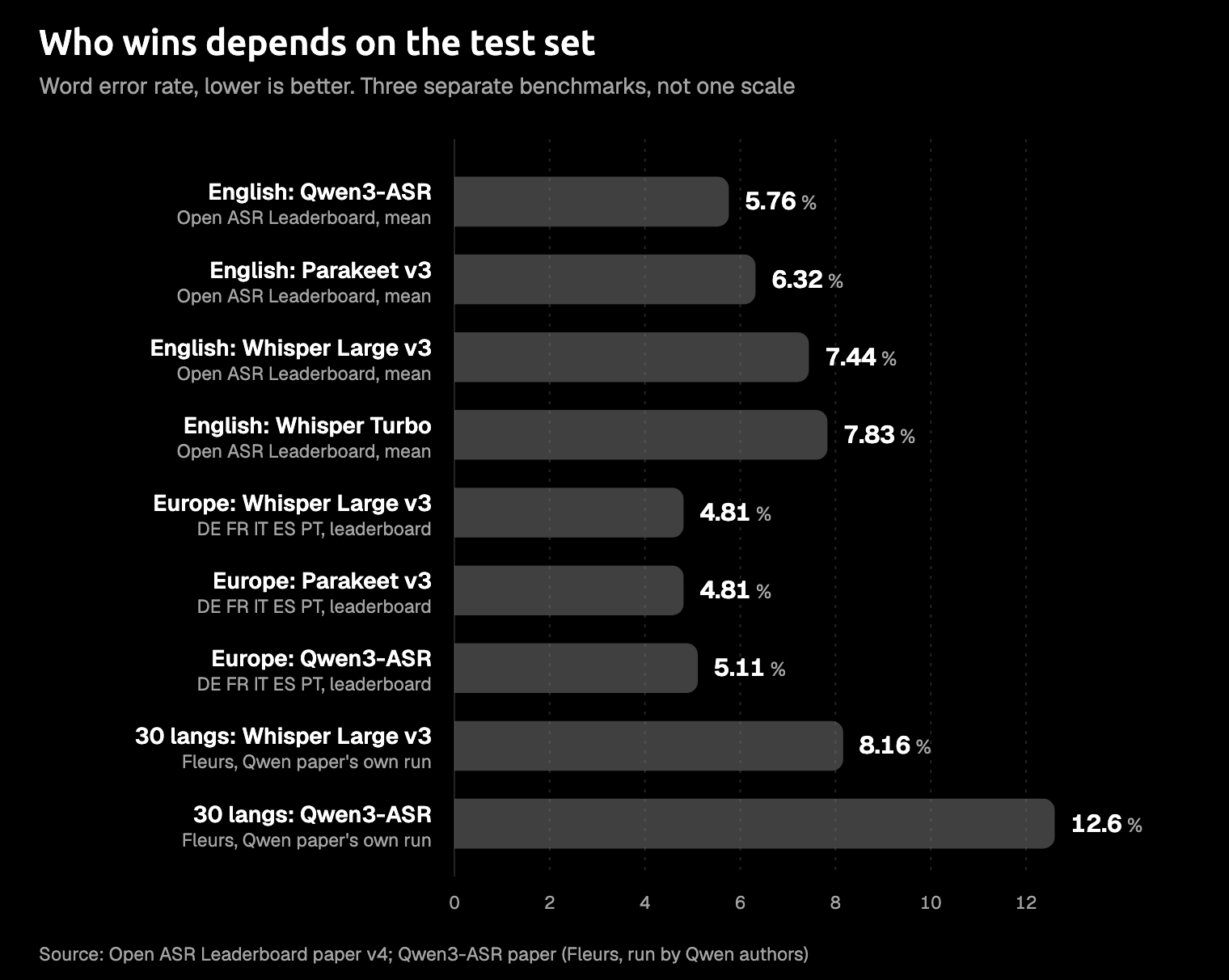
So "Qwen beats Whisper" holds for most English benchmarks, Chinese, and Cantonese. Across many languages at once, it doesn't.
Japanese, and Japanese mixed with English
Japanese
If you dictate in Japanese, here's what's missing: no primary source gives a Japanese-only number for Qwen3-ASR. The Qwen paper pools Japanese into larger multilingual test sets and has no per-language appendix, and the Open ASR Leaderboard has no Japanese track.
If you're looking for a Japanese number, the only per-language figure we found comes from WhisperNotes' FLEURS run. Japanese is scored by character error rate (CER) instead of WER, because written Japanese doesn't put spaces between words. On Japanese, Qwen3-ASR 1.7B scored 5.74% CER and Whisper Large v3 Turbo scored 5.30%, a near tie within error bars.
Check what this test covers before you rely on it. It's a competitor's run on read speech, with about 150 sentences per language, last updated October 17, 2026. In WhisperNotes' own words, FLEURS is "not a meeting and not dictation".
The same run shows that Japanese isn't the only close call. If a gap sits inside the run's error band, it's small enough that you can't tell it apart from noise. Korean (3.54 against 4.25) and Chinese (6.49 against 7.97) also sit inside that band, so of the four languages in the chart below, only Cantonese is a clear Qwen lead, at 6.44 against 36.75.
Qwen's own paper shows a clearer Chinese gap: 2.41 against 4.09 for Whisper Large v3 on Fleurs Chinese, with Whisper run by the Qwen authors. So on Chinese, Qwen leads clearly in its own tests and only slightly in this vendor run against Turbo.
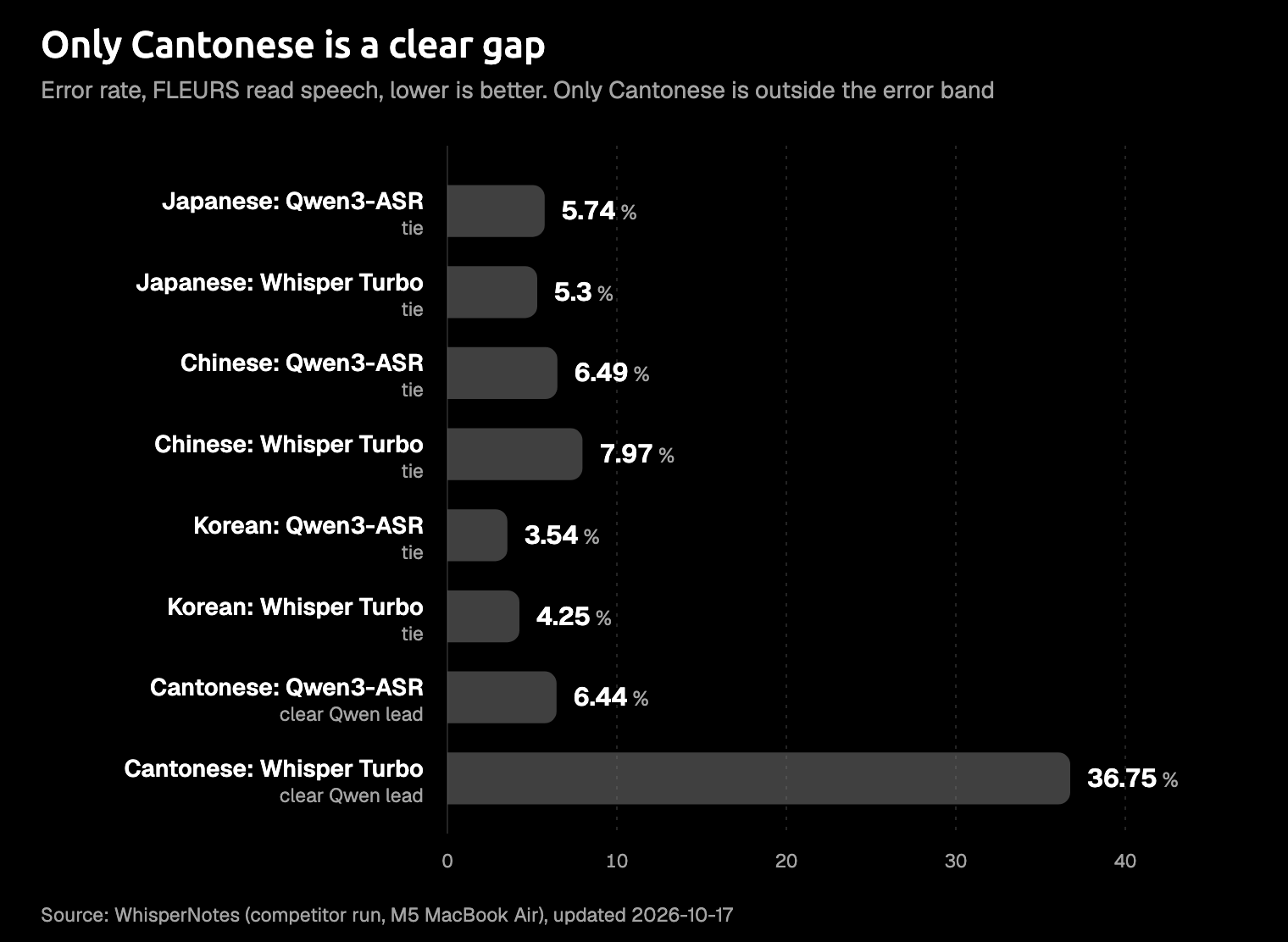
The verdict for Japanese: Qwen isn't a reason to switch. If you're curious, test both on your own voice, with your own names and the words you use at work.
Mixed Japanese and English
If you're a Japanese user, this may be the question you care about most. We found no published code-switching result (switching languages in the middle of a sentence) for Qwen3-ASR, for Japanese and English or any other pair, and its README doesn't address it.
If you want to try it yourself, record a mixed clip and leave Qwen3-ASR's language option on None, so it auto-detects. You can also force one language per call, but that doesn't help when you switch mid-sentence.
That's the test that would settle it, and we haven't run it yet.
If you mix Japanese and English every day, Amical Cloud handles both in the same sentence, and it covers 100+ languages. There's no public benchmark of the mixed case yet. Here's the kind of thing you might say in Slack. Both blocks below are made up to show the idea, not recorded from Amical:
えーと、明日のmeetingなんだけど、slidesはもうshareしたから、feedbackあったらSlackでちょうだい
Amical Cloud transcribes both languages, and then AI formatting cleans up the text for Slack. It drops the filler and keeps your casual tone, so the message could look like this:
明日のmeetingなんだけど、slidesはもうshareしたから、feedbackあったらSlackでちょうだい。
Multi-language support lists the languages, and this guide shows you how to set them up.
Streaming and speed
Live transcription
Streaming means text appears while you're still talking. For push-to-talk dictation, streaming matters less than it sounds. You hold a key, speak, and let go, and the clip is decoded after you release it. What counts is how long you wait for that.
Qwen3-ASR does offline and streaming transcription in one model. The catch is that if you want the official package to stream, you need vLLM, a server for running models on a GPU, and you lose batching and timestamps in streaming mode.
You may also see a 92 ms latency figure. That's the average time to first token for the 0.6B model, one request at a time, on a GPU under vLLM, so don't expect it on a Mac.
On a Mac, the community mlx-qwen3-asr port is the only route we found that documents streaming, with a mic mode that re-decodes a moving window of audio.
Speed
On a GPU, the Open ASR Leaderboard measures speed as RTFx: how many seconds of audio a model transcribes per second of compute, so higher means you wait less. Parakeet leads by far at 3330, then Turbo at 200, Qwen at 148, and Large v3 at 146.
If you dictate on an Apple Silicon Mac, the order between Qwen and Turbo flips, at least in two vendor runs. In WhisperNotes' short-clip test on an M5 Air, Qwen ran at 9.6x real time and Turbo at 2.6x, and Parakeet v3 was much faster than both. Qwen used more memory, though: 2.43 GiB at peak against 1.87 GiB for Turbo. Soniqo, another vendor, also found Qwen faster than Turbo on an M5 Pro with English read speech, but its page has no date and its two pages disagree on the Whisper numbers.
That's a weak spot for our local-mode Japanese pick: in WhisperNotes' run, Turbo was the slowest of the three on a Mac. These are WhisperNotes' numbers on its own setup, and there's no published speed figure for Amical's local mode. If speed matters most, use Amical Cloud, which returns short dictations in under 300 ms by Amical's own figures (no public benchmark yet).
If you dictate in one of Parakeet's 25 European languages, Parakeet is the one to beat on speed on a Mac, at least in WhisperNotes' run. It doesn't cover Japanese, Chinese, or Korean, so it's no option there, and Parakeet vs Whisper covers the European matchup.
How to run Qwen3-ASR on a Mac
You'll need an Apple Silicon Mac for the MLX routes; MLX is Apple's framework for running AI models on its own chips. Each route below is a Python package or command-line tool, not a dictation app, so you'll mostly be transcribing recordings, not typing into your email.
mlx-audio
mlx-audio runs several speech models on Apple Silicon, including Qwen3-ASR, Whisper Turbo, and Parakeet v3.
pip install mlx-audioUse the model mlx-community/Qwen3-ASR-1.7B-8bit, which is a 2.46 GB download. Because the same tool runs all three models, it's the easiest way to compare them on your own recordings.
mlx-qwen3-asr
This is a community port built only for Qwen3-ASR.
pip install mlx-qwen3-asrThe 1.7B model is a 2.0 GB download at 8-bit or 1.2 GB at 4-bit, and the --mic mode streams from your microphone.
transcribe.cpp
transcribe.cpp is an MIT-licensed library written in C and C++. A Mozilla.ai post calls it "llama.cpp for STT models". On Apple Silicon, it uses Metal, Apple's GPU interface, automatically. It runs GGUF builds (a compact model file format): the 1.7B model is 2.19 GB at Q8_0 or 1.32 GB at Q4_K_M, and it takes 16 kHz mono WAV audio. When we checked, we found no official whisper.cpp or llama.cpp support for Qwen3-ASR, and these GGUF files are built for transcribe.cpp.
If you want Qwen's official qwen-asr package instead, it installs with pip and recommends Python 3.12. If you want to stream with it, you'll need vLLM, which means a GPU server.
The best test is your own voice:
- Record two minutes of the way you actually dictate, with your own names and numbers.
- Run the file through
mlx-community/Qwen3-ASR-1.7B-8bitand thenmlx-community/whisper-large-v3-turbo-asr-fp16in mlx-audio; the mlx-audio README shows the command. - Count the mistakes that matter to you, like names and numbers.
Qwen, Whisper or Parakeet for dictation
A model isn't a dictation app. To dictate with any of these, you still need a hotkey, a microphone, something that pastes the text into the app you're in, and some cleanup, since a raw transcript keeps every "um". Here's how to choose by situation:
- Chinese, Cantonese, dialects, or very noisy rooms: Qwen3-ASR, through one of the routes above.
- Japanese: it's close to a tie, so Whisper Large v3 Turbo is the easy route, or Amical Cloud if speed on a Mac matters most. Turbo is about a 1.5 GB download in Amical's local mode, or about 3.1 GB for the full Large v3, and Turbo vs Large v3 explains the difference.
- Japanese mixed with English: Amical Cloud, which handles both in the same sentence.
- European languages, fastest local model: Parakeet v3, which covers only 25 European languages (no Japanese, Chinese, or Korean), and is also a local option in Amical (our Parakeet v3 guide).
- Less common languages: Whisper, with 99 languages.
- Fastest to text, on your phone too, 100+ languages: Amical Cloud, by Amical's own latency figures (no public benchmark yet).
Our pick, as the people who make it, is Amical. For Japanese, use Whisper Turbo in local mode, where speech-to-text stays on your computer (choose a local formatting model through Ollama, a tool that runs language models on your computer, if you want the whole pipeline offline). Use Amical Cloud if you mix English into your Japanese or want the shortest wait. Either way, Amical gives you what a model alone doesn't: you hold Fn, speak, and Amical pastes the text into the app you're in. Then its AI formatting rewrites your words for that app, so you get a proper email in Gmail or a short reply in Slack, not a transcript.
Custom vocabulary helps keep your names and jargon spelled right. Qwen's README documents no such option, though its paper says context you give it in the prompt acts as background knowledge. Local AI models and Cloud AI models explain both of Amical's modes, and Custom vocabulary shows you how to add names.
A few things to know before you pick:
- Amical doesn't run Qwen3-ASR. If Chinese or Cantonese is your main language, try Qwen through mlx-audio or transcribe.cpp. For Japanese, the published gap with Turbo is within error bars, and Turbo is a single download in Amical.
- Local mode on a Mac needs macOS 15 or later, and it's slower on Intel Macs, which run it without the GPU. Amical Cloud has neither limit.
- Amical Cloud needs sign-in, and your audio and some context for formatting go to Amical's servers. Local mode needs no account. In local mode, speech-to-text runs on your computer and your audio stays there; your text leaves only if you choose a cloud provider for AI formatting.
Try it on your own voice
Download Amical and dictate one real paragraph in Japanese, or in whatever language you work in, with Whisper Large v3 Turbo in local mode. Then switch to Amical Cloud, dictate the same paragraph (with some English mixed in, if that's how you talk), and compare the two. The free plan covers your test, with unlimited local dictation and a weekly allowance of cloud words, and Pricing has the details.