You want a speech model that runs on your own computer, and you've narrowed it to two from NVIDIA's Parakeet family of open speech-to-text models. Parakeet Unified EN 0.6B and Parakeet TDT 0.6B v3 are both 600M-parameter models, released about eight months apart.
Here's the short version of Parakeet Unified vs v3. If you dictate in English and your app writes the text after you let go of the key, Unified has a modest lead: a word error rate of 5.91 against 6.34, averaged over the same eight Open ASR Leaderboard test sets and self-reported on each model's card. Pick v3 if you dictate in any of the other languages on its list of 25, or if you want timestamps, which v3's card documents and Unified's doesn't mention.
This guide is for you if you dictate in English and you're choosing a local model.
A note on who's writing: Amical publishes this blog. Amical is a dictation app whose local Parakeet model is v3, on Mac and Windows, and you get custom vocabulary and AI formatting with it. It also sells unlimited use of Amical Cloud, its own hosted speech model, as a Premium subscription. We haven't run our own same-machine test of these two models yet, so every model accuracy figure here comes from NVIDIA's model cards, with the source named.
Side by side
Here's how the two compare on each model's card, so you can see the differences in one place.
| Parakeet Unified EN 0.6B | Parakeet TDT 0.6B v3 | |
|---|---|---|
| Released on Hugging Face | April 2026 | August 2025 |
| Size | 600M parameters | 600M parameters |
| Architecture | FastConformer encoder, RNN-T decoder | FastConformer encoder, TDT decoder |
| Languages | English only | 25 European languages, detected automatically |
| Offline English WER, average of 8 Open ASR Leaderboard sets (card) | 5.91 | 6.34 |
| Streaming | Buffered, 2.08 s down to 0.16 s, with WER published | Example chunking script, no streaming WER published |
| Timestamps | Not mentioned on the card | Word and segment level |
| License | NVIDIA Open Model License | CC-BY-4.0 |
| Official runtime | NVIDIA's NeMo toolkit, Linux preferred | NeMo, plus a GGUF build and Hugging Face Transformers |
Both models use a FastConformer encoder, the part that listens to the audio. RNN-T and TDT are two kinds of decoder, the part that turns what the encoder heard into words. You don't need the theory to choose, because the benchmarks below tell you more than the names do. Both models write punctuation and capital letters on their own; the WER scores below just don't count punctuation when they mark errors.
In the runtime row, NeMo is NVIDIA's developer toolkit for its speech models, and GGUF is a single-file format that lets you run a model on an ordinary computer in apps that support it.
What "unified" actually means
Speech models can work in two ways. Offline means the model gets your whole recording at once and transcribes it. Streaming means it transcribes live, in short chunks, while you're still speaking.
Unified does both jobs with one trained model rather than two.
NVIDIA trained it in both modes at once, with an extra training loss that keeps the streaming output close to the offline output. The paper behind it says the point is to avoid building and maintaining two separate models.
You choose the latency, from 2,080 ms down to 160 ms in 80 ms steps. Latency here is the chunk length plus the "right context", a short piece of audio after the chunk that the model hears before it commits to the words.
One limit if you're building something: Unified's streaming redoes the work on earlier audio for every new chunk, rather than reusing it. If you need streaming that reuses that work, NVIDIA's Nemotron streaming model is built that way, and our Nemotron streaming guide covers it.
v3 can transcribe in chunks too, with an example script on its card. But the card publishes no streaming accuracy, so you have nothing to compare.
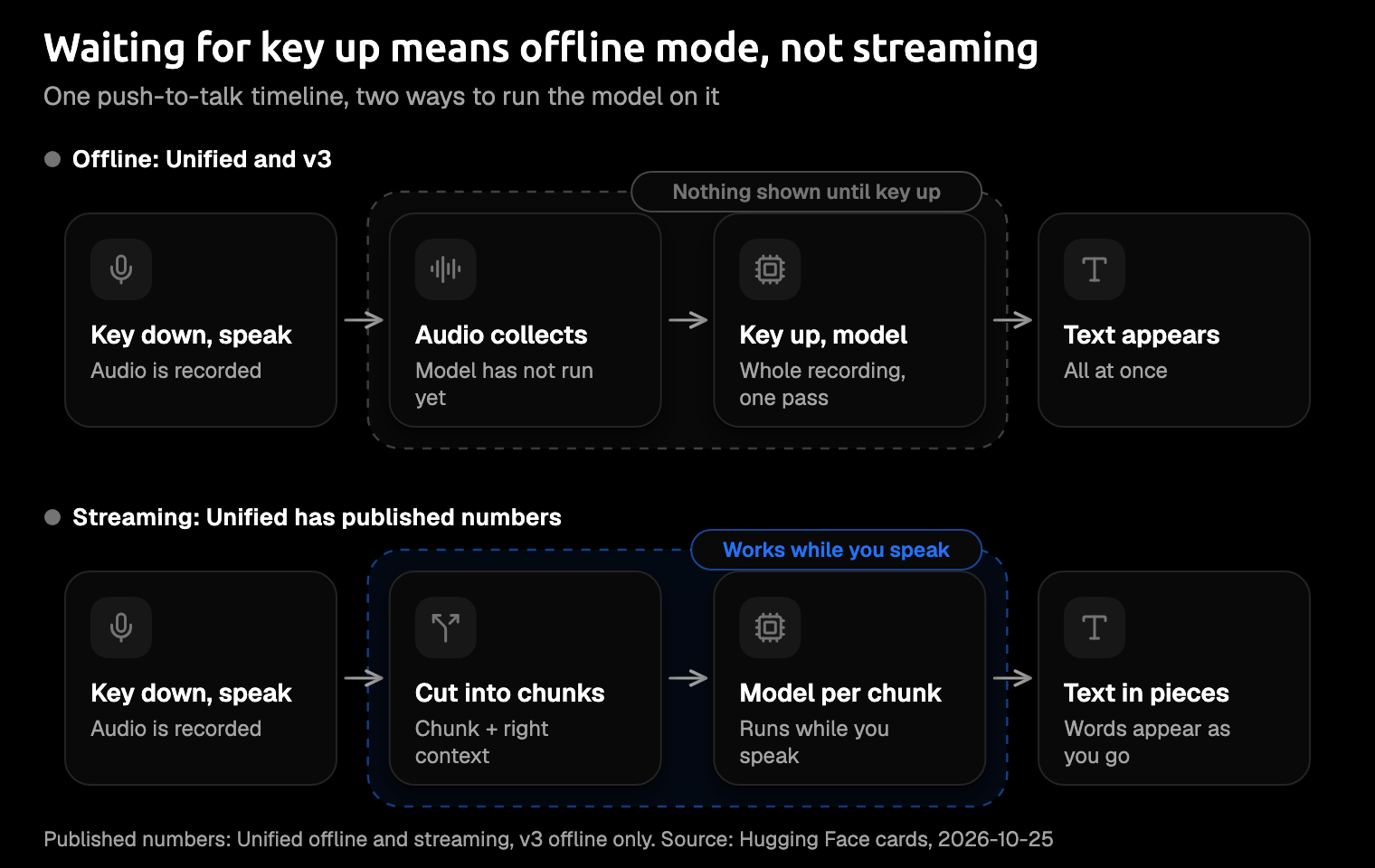
Hold a key, speak, let go: that's offline mode. Streaming is when text arrives while you're still talking.
Accuracy, like for like
Word error rate (WER) is the share of your words a model gets wrong, written as a percentage, so lower is better.
Both cards report offline English WER on the same eight test sets from the Open ASR Leaderboard, Hugging Face's public speech recognition benchmark, with punctuation not scored. That's the one fair comparison between these two models, and every accuracy number in this section is that offline English figure.
Unified is lower on six of the eight sets, most clearly on SPGI, a set of financial calls, while v3 is lower on GigaSpeech and on TEDLIUM, a set of recorded talks.
So read it as "ahead on average", not "ahead everywhere".
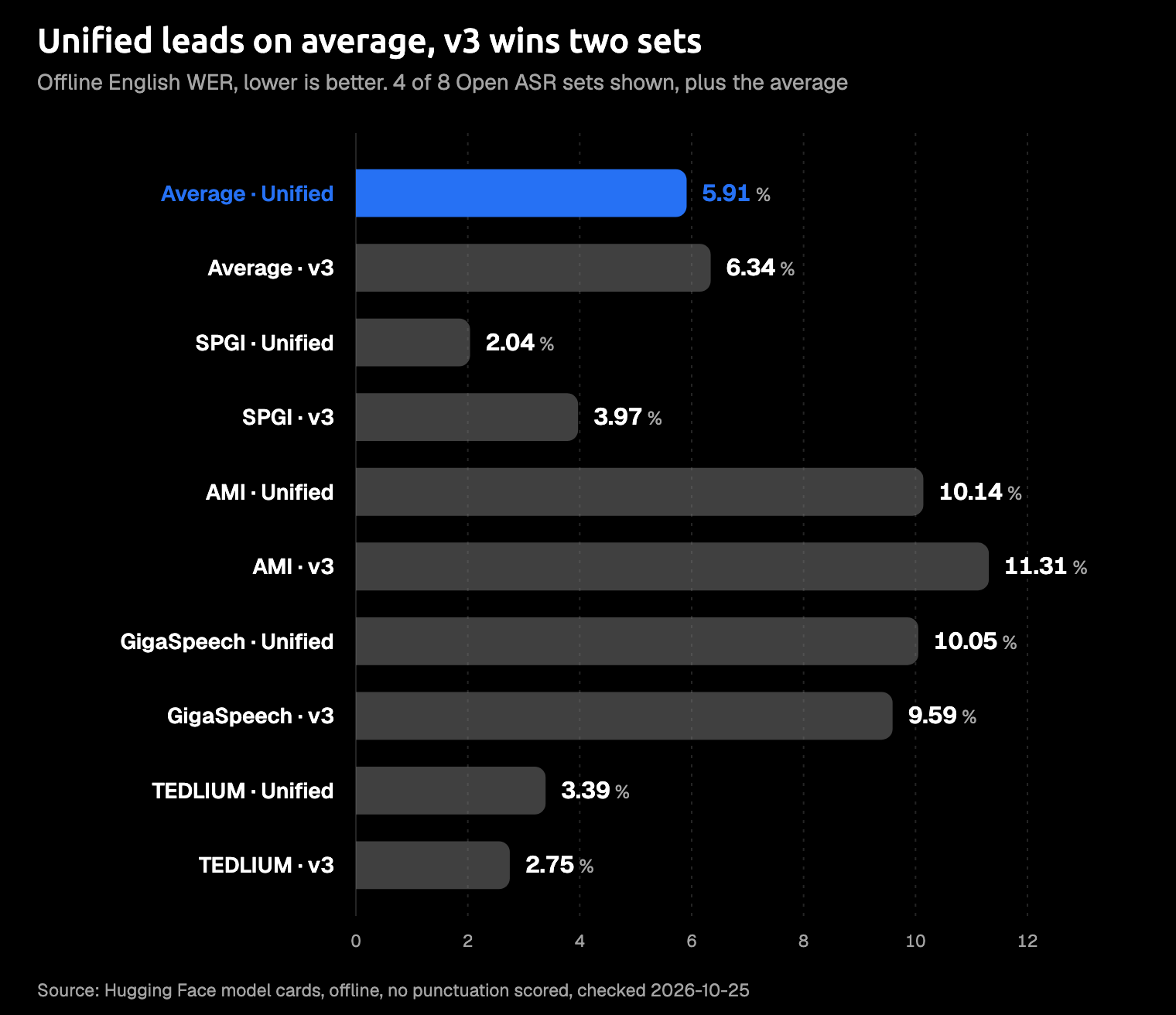
Self-reported on each model's Hugging Face card, offline, punctuation not scored; checked 2026-10-25. The chart shows four of the eight sets, plus the average of all eight.
Here are all eight sets, from the same two cards. The lower score in each row is in bold.
| Test set (offline English WER) | Unified | v3 |
|---|---|---|
| AMI | 10.14 | 11.31 |
| Earnings-22 | 11.16 | 11.42 |
| GigaSpeech | 10.05 | 9.59 |
| LibriSpeech clean | 1.63 | 1.93 |
| LibriSpeech other | 3.11 | 3.59 |
| SPGI | 2.04 | 3.97 |
| TEDLIUM | 3.39 | 2.75 |
| VoxPopuli | 5.77 | 6.14 |
| Average | 5.91 | 6.34 |
The cards differ in setup, though. They were made months apart with different versions of NVIDIA's NeMo toolkit: 2.4 for v3 and 2.7.3 for Unified. Unified's card names its text normalizer (whisper-normalizer 0.1.12, the step that tidies text before scoring), and v3's card doesn't name one for its leaderboard table. v3's card metadata also lists a mean of 6.32 next to the 6.34 average in its table. So you should treat a lead of less than half a point as a small gap. On a different test set the order could flip, as it already does on GigaSpeech and TEDLIUM.
If you use Amical, here's the trade in plain terms. Amical's local Parakeet is v3, so you won't get Unified's English edge there, and that edge is under half a point on NVIDIA's own cards. What you do get with v3 in Amical is custom vocabulary for your names and jargon, and AI formatting that rewrites your words for the app you're in. Neither one is part of a WER score, so they don't change the numbers above; they change what lands in your email or Slack message.
If speed matters most to you, Amical Cloud returns a short dictation in under 300 ms, by Amical's own figure rather than a public benchmark.
Some numbers you'll see online don't belong in this comparison. v3's English Fleurs, CoVoST and background-noise results have no match on Unified's card. Community ports of Unified (copies converted to other file formats) report WER on other test subsets with other scoring. And v3's card lists a speed figure (RTFx, how fast it transcribes compared with real time) while Unified's lists none, so you can't compare speed fairly either.
What streaming costs
Unified's card has a table of its average WER at each latency, on the same eight sets. Offline it's 5.91, and streamed it's 6.14 at 2.08 s, 6.29 at 1.12 s, and 6.52 at 0.56 s. Below that, it climbs fast, to 8.44 at 0.16 s, the shortest latency the card supports.
The card says so itself: quality drops at 160 ms, because there's so little right context. It lists an 80 ms row too, at 15.63, but that's below its 160 ms floor, and for 80 ms NVIDIA recommends its Nemotron streaming model instead.
The practical read: if you allow about half a second or more, streaming costs you little accuracy, about 0.6 points on the average. Below that, each step down costs you more than the last.
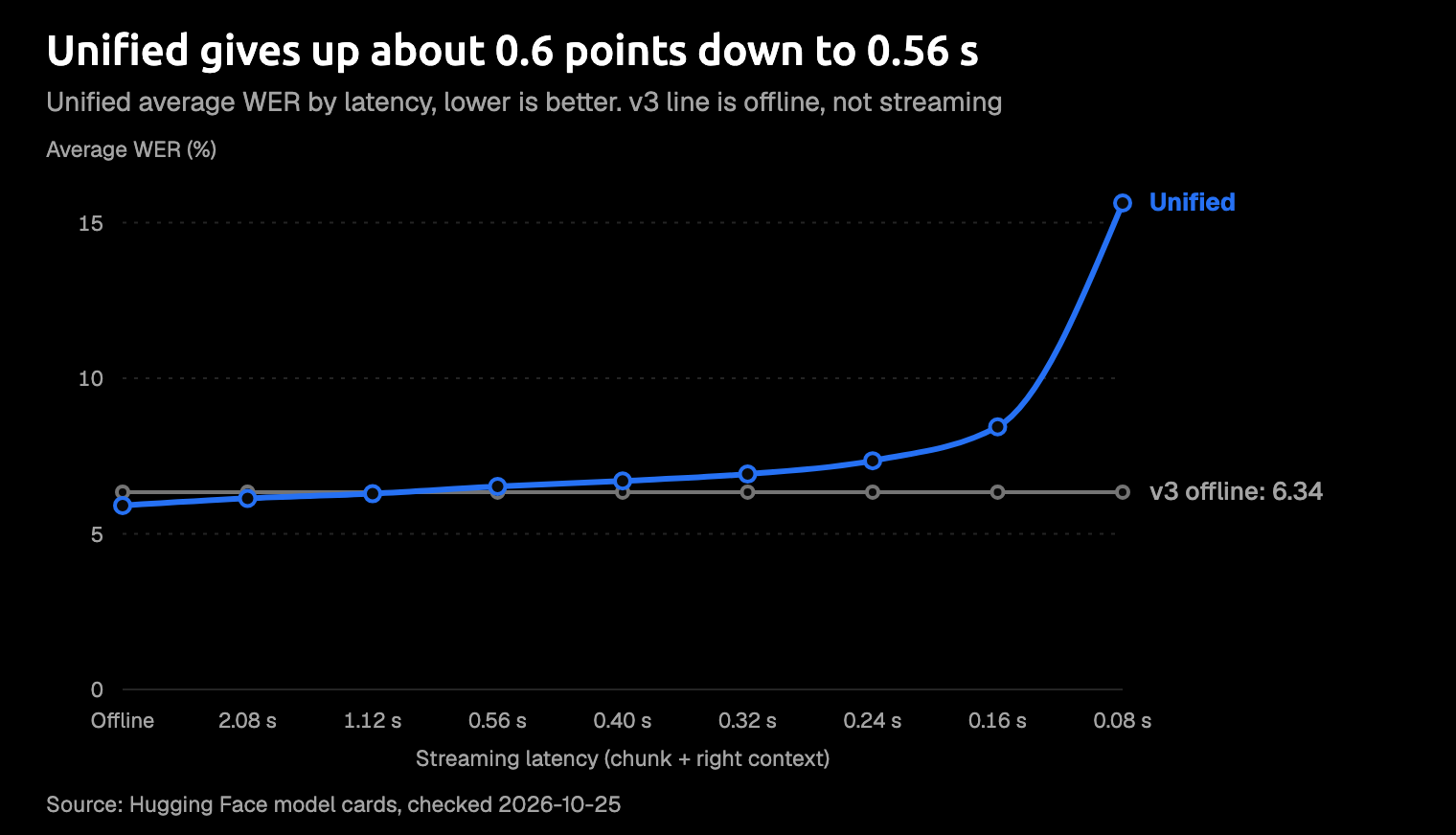
Unified's average English WER by streaming latency, from its Hugging Face card, checked 2026-10-25. The 0.08 s point is below the card's 160 ms floor, where NVIDIA points to Nemotron instead. The flat v3 line is its offline score, for reference only.
That v3 line is there for scale, not as a match-up. v3 has no published streaming figure, so the chart can't tell you how v3 would do if you streamed it.
Does streaming matter for push-to-talk dictation?
This part is our reading of the card numbers, not a test.
Most dictation works like this: you hold a key, speak, and let go. If your app transcribes after you release the key, it sends the whole recording to the model. That's offline mode, where Unified has its best score.
So with push-to-talk, Unified's streaming side doesn't come into play. Your choice comes down to the offline numbers above, your language, and what your app supports.
Streaming matters when you want words to appear while you talk, such as long hands-free dictation or live captions. There, Unified keeps most of its accuracy if you allow half a second to a second of latency, as the chart above shows.
Amical's dictation includes the push-to-talk kind: you hold your push-to-talk key (Fn by default on Mac), speak, and the text is pasted where your cursor is. One recording session can run up to 2 hours, and in hands-free mode it stops on its own after 5 seconds of silence; while you hold the key, a pause for thought won't cut you off. The AI dictation page has the details.
Languages, timestamps and long audio: where v3 wins
v3 covers 25 European languages and detects the language on its own, so it can tell your French email from your English one. If you want timestamps, v3 gives you word and segment timestamps, which help you jump to a spot in a recording. And if you have long files, it handles up to 24 minutes in one pass on a datacenter GPU, or about 3 hours with a memory-saving setting.
If you pick Unified, you get English only, no timestamps mentioned on its card, and a maximum length that depends on your GPU's memory.
For dictation, long audio rarely decides it: a Slack reply is over long before any length limit matters. Timestamps and long files matter more if you transcribe meetings or podcasts.
Japanese isn't on v3's list, and neither are Chinese or Korean. If you dictate in Japanese, or switch between Japanese and English, you'll want something other than Parakeet. Amical Cloud covers 100+ languages, and Whisper in Amical's local mode covers 99. See Multi-language support to set it up.
License, in plain terms
v3 uses CC-BY-4.0. You can use it, change it and share it, commercially too, as long as you credit NVIDIA, link the license, and say if you changed it.
Unified uses the NVIDIA Open Model License. Commercial use is fine, NVIDIA claims no ownership of what the model outputs (your transcripts), and you can build and share models based on it. If you redistribute it, you pass on the license and a notice that NVIDIA licensed it. Your rights end if you sue claiming the model infringes copyright or patents, or if you bypass its safety guardrails without a similar replacement.
If you're dictating, neither license gets in your way. They matter if you ship the model inside a product. This is a plain-language summary, not legal advice.
Which apps run which (October 2026)
Here's what each app's own page says, as of October 2026. Some of these pages carry no date, so check them before you download.
- Handy runs both. v3 is one of its listed models, and Unified is a manual install: you download the GGUF file yourself, and Handy recommends the Q8_0 one.
- Spokenly runs both. On Mac, Unified is 1.2 GB and needs Apple silicon, while v3 is 496 MB and the one Spokenly recommends on Intel Macs. On Windows, both run as GGUF files, and on Linux it offers only v3.
- MacParakeet uses v3 by default, with Unified as an English-only option.
- FluidVoice, OpenWhispr and VoiceInk don't name Unified on their pages.
So it depends on your app. In Handy, you install Unified by hand; Spokenly lists both; MacParakeet defaults to v3, with Unified as an option you can pick.
Officially, Unified runs in NVIDIA's NeMo toolkit, with Linux and NVIDIA GPUs as the stated targets. The community has also converted it for ordinary Macs and PCs: Hugging Face lists 28 derivative versions, most of them GGUF, ONNX, CoreML or MLX conversions. Handy's GGUF build is the most downloaded. Quantized files store the model's numbers at lower precision, so you download less: Handy's Q8_0 file, the one it recommends, is 731 MB, and its smaller Q4_K_M file is 477 MB.
Amical's local Parakeet is Parakeet TDT 0.6B v3, on Mac and Windows, next to six Whisper models and in the same app as Amical Cloud. It works offline once you've downloaded it, it's unlimited on the Free plan, and your custom vocabulary and AI formatting apply to it. The Local AI models page explains how local mode works.
If you're on Linux: Amical doesn't run there. Handy runs on Linux and lists both models, though its Unified file is a manual install and its page doesn't say whether that's tested on Linux.
Which should you pick?
- English, and your app offers Unified: Unified, for its lower self-reported average WER, keeping in mind the lead is under half a point.
- English in Amical: v3, Amical's local Parakeet, with custom vocabulary for your names and jargon and AI formatting on top. Or switch to Amical Cloud.
- Any of v3's other European languages, automatic language detection, timestamps (documented on v3's card, not mentioned on Unified's), or long files: v3.
- Spokenly on an Intel Mac or on Linux: v3, the one Spokenly recommends or offers there.
- Live text at very low latency: Nemotron streaming, since Unified's own card says it degrades at 160 ms and recommends Nemotron for 80 ms. See our Nemotron guide.
- Japanese or other languages outside v3's list: Amical Cloud (100+ languages) or Whisper in Amical's local mode (99).
- Speed above all: Amical Cloud, which returns a short dictation in under 300 ms by Amical's own figure, not a public benchmark; we haven't timed it against local Parakeet.
Amical publishes this blog, so here's our case. You don't have to pick one route forever, because Amical gives you local and cloud in one app. In local mode, you get Parakeet v3 and six Whisper models, offline once downloaded and unlimited on the Free plan. With Amical Cloud, Amical says a short dictation comes back in under 300 ms and a longer one in under 500 ms; that's Amical's own figure, not a public benchmark, and it's for Amical Cloud, not local Parakeet.
Either way, AI formatting rewrites what you said for the app you're in. You get a proper email in Gmail or a clean prompt in Cursor, not a raw transcript you fix by hand for the third time.
Three limits, plainly. Amical's local Parakeet is v3, so you won't get Unified's English edge there. That edge is under half a point on NVIDIA's cards, and in Amical you get v3 with custom vocabulary and AI formatting, or Amical Cloud. If you want Unified itself, Handy lists it as a manual GGUF install. On a Mac, Parakeet v3 runs on macOS 14 or later, Intel Macs included. Amical's local Whisper models need macOS 15 or later and are slower on Intel Macs, and Amical Cloud has no such limit. Amical doesn't run on Linux, where Handy is one option for these two models.
For the wider field, see the best speech recognition models in 2026. For v3 on its own, read our Parakeet TDT v3 guide, and if Whisper is still on your list, see Parakeet vs Whisper.
Try it on one real message
Download Amical, choose Parakeet v3 as your local model, and dictate one real English message, like the Slack reply you'd otherwise type next. Then dictate the same message with Amical Cloud and compare the two. The Free plan includes unlimited local dictation and 2,000 cloud words a week, which is plenty for that test. If you end up wanting unlimited cloud words, see Pricing.