You saw Voxtral on Hacker News, opened a row of Hugging Face tabs, and now you're not sure which model all the fuss was about. Fair enough. Mistral has shipped three generations of Voxtral speech models, and the answer to "Voxtral vs Whisper" changes with each one.
Only some Voxtral models can be downloaded. The one that streams, Voxtral Realtime, writes words as you speak, but officially it wants a graphics card with 16 GB of memory. Whisper, OpenAI's open speech-to-text model, runs on the laptop you already have, whether that's a recent Mac or a Windows PC.
So does Voxtral beat Whisper? On accuracy, the open Voxtral models and Whisper are close to a draw.
On what you can run yourself today, Whisper wins.
For dictation, our pick is Amical. Full disclosure: Amical publishes this blog, and it doesn't run Voxtral. In local mode it runs Whisper or Parakeet, NVIDIA's open speech model, on your own Mac or Windows PC. Amical Cloud, Amical's own speech model built for low latency, is there when you want finished text fast.
The short answer
On accuracy, the open Voxtral models and Whisper are close, and Mistral says its newer Small Transcribe 3 beats Whisper on its own chart. The bigger split is what you can run yourself. Open weights means the model files are public, so you can download them and run them on your own hardware. Voxtral's July 2025 models and Voxtral Realtime are open weights; Mini Transcribe 2 and the Voxtral 3 family are not. Whisper Large v3 and Large v3 Turbo are open too.
Whisper also runs on everyday laptops, because the tools have had years to catch up. Its age helps.
| Model (released) | Open weights? | Languages | Runs on a laptop? | Streams as you speak? |
|---|---|---|---|---|
| Voxtral Mini 3B and Small 24B (July 2025) | Yes, Apache-2.0 | 8, no Japanese | No: about 9.5 GB and 55 GB of GPU memory | No, recorded files |
| Voxtral Realtime (February 2026) | Yes, Apache-2.0 | 13, Japanese included | Not officially: a 16 GB+ GPU | Yes, with an 80 ms to 2.4 s delay |
| Voxtral Mini Transcribe 2 (February 2026) | No; Mistral's API, or on-premise and private-cloud setups | 13 | No | No |
| Voxtral 3 family (October 2026) | No; self-deployment through Mistral's sales team | Over 50 (batch) | No | Realtime 3 does |
| Whisper Large v3 and v3 Turbo | Yes, permissive (Turbo: MIT) | 99 | Yes; in Amical, on Windows or macOS 15+ | No, 30-second windows |
For private dictation, use Whisper or Parakeet in Amical's local mode, where your audio stays on your computer. For finished text fast, use Amical Cloud. Try Voxtral Realtime if you have the GPU or enjoy tinkering, and Voxtral 3 if you're building on an EU-hosted API.
Which Voxtral is which
Mistral's naming is the hardest benchmark in this post.
It's a family tree where half the cousins are called Mini, and the one thing you most want to know (can I download it?) isn't in the name.
Voxtral Mini 3B and Small 24B (July 2025)
The first pair is open weights under Apache-2.0, a permissive open source licence. They cover 8 languages: English, Spanish, French, Portuguese, Hindi, German, Dutch, and Italian. Japanese isn't on the list.
They're built for recorded files of up to 30 minutes, and they're big: Mini needs about 9.5 GB of GPU memory, and Small about 55 GB. Mistral retired its hosted Mini API on May 31, 2026, though the weights are still on Hugging Face.
Good on a server. Not a laptop dictation model.
Voxtral Realtime and Transcribe 2 (February 2026)
In February 2026, Mistral split the line in two. Voxtral Mini 4B Realtime is open weights under Apache-2.0, with about 4B parameters and 13 languages, Japanese included. It streams, so words appear while you talk, behind a delay you choose: anywhere from 80 ms to 2.4 s, with 480 ms recommended. Its batch sibling, Voxtral Mini Transcribe 2, covers 13 languages too, but it isn't open weights. Mistral sells it through its API, and the launch post also mentions on-premise and private-cloud setups, without giving terms.
If privacy is why you're here, Realtime is the Voxtral worth your attention. It's the only open one that streams.
Voxtral 3 (October 2026)
Voxtral 3 arrived in October 2026 with three transcription models: Mini Transcribe 3, Small Transcribe 3, and Mini Transcribe Realtime 3. Mistral offers them as an EU-hosted API, or for self-deployment on your own infrastructure, arranged through its sales team. The launch post doesn't mention open weights, and Mistral's model list marks all three as Premier rather than open. The batch models cover over 50 languages.
It's Mistral's newest API. As of late October 2026, what you can't do is download it tonight and try it.
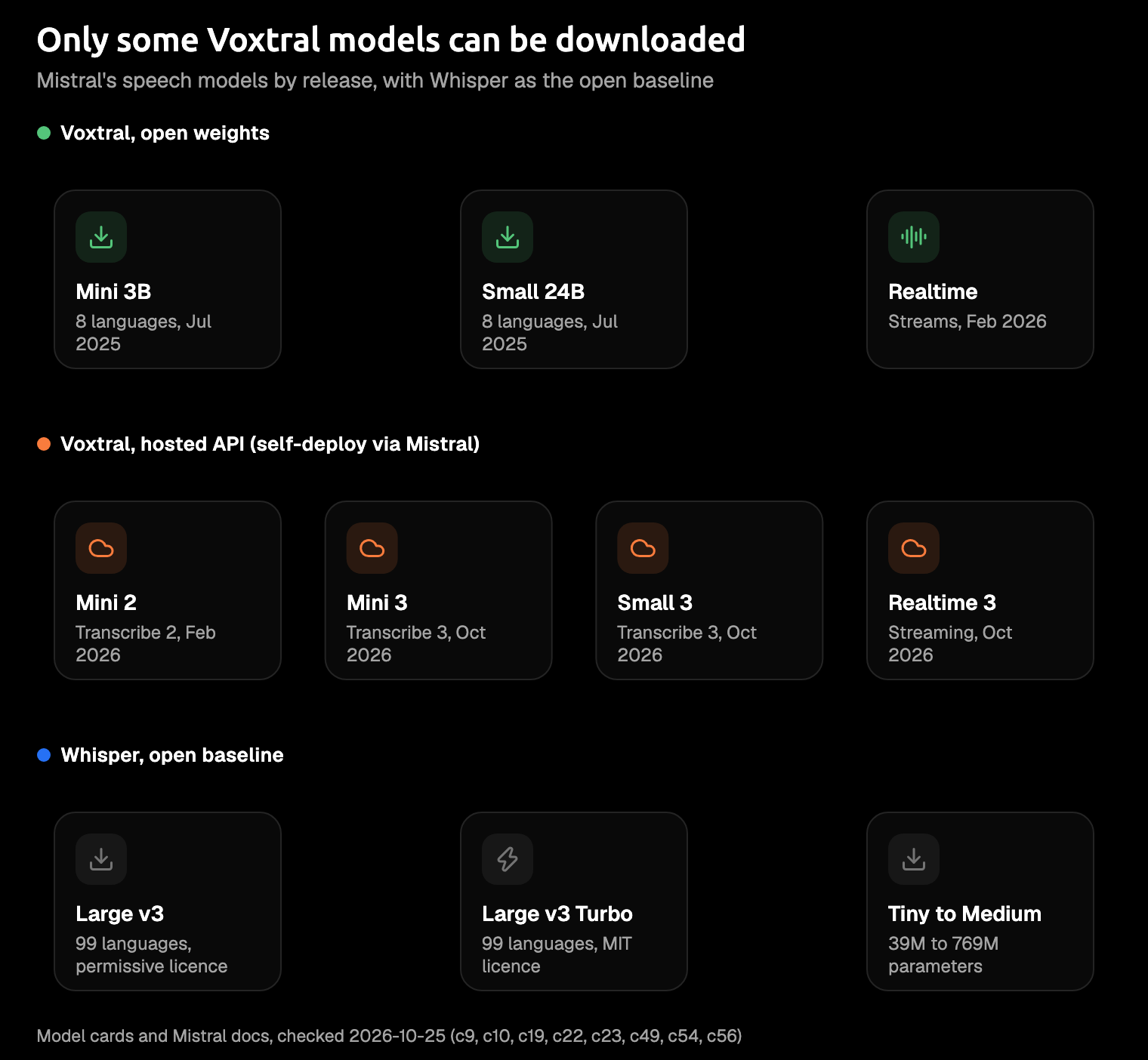
Which Voxtral models you can download, with Whisper as the open baseline, from Mistral's model cards and model list.
Accuracy: what the published numbers say
On the published numbers, Whisper Large v3 lands within a point of every open Voxtral model. That's a draw, not a knockout.
Word error rate (WER) is the share of words a model gets wrong, so lower is better. Three sources publish WER for these models, and every number here is theirs, not ours. They use different test sets and none of them is dictation, so read them as hints, not a ranking.
The Open ASR Leaderboard. This public ranking of speech models averages WER across several English test sets. As listed on each model card in October 2026, Voxtral Small 24B scores 6.62, Mini 3B 7.05, Whisper Large v3 7.44, Voxtral Realtime 7.68, and Whisper Large v3 Turbo 7.83. So two Voxtral models edge out Whisper Large v3, and Realtime trails it slightly.
You'd struggle to hear gaps that small in an email.
None of these charts describes Amical Cloud, which runs Amical's own speech model, not Whisper.
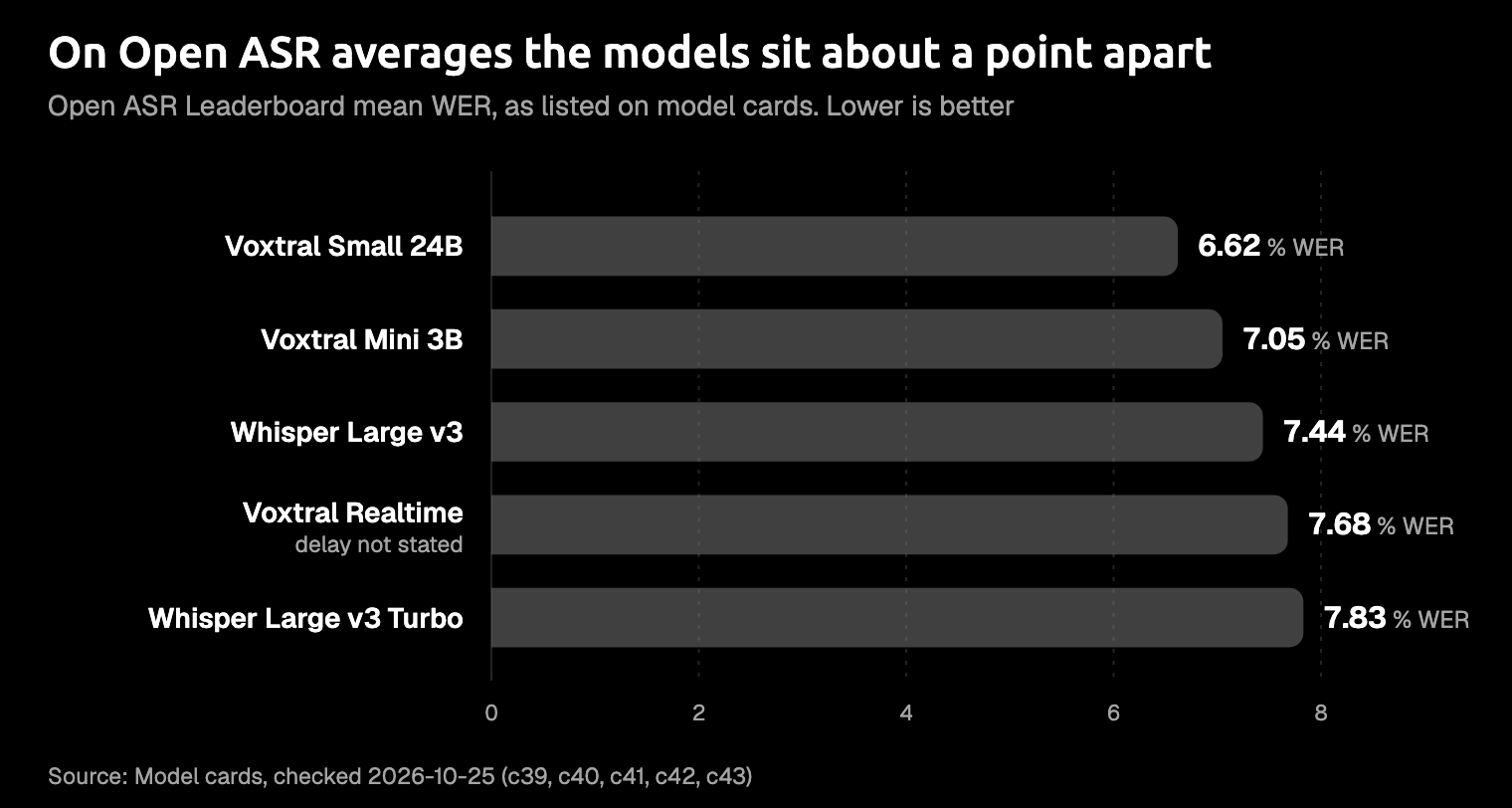
Open ASR Leaderboard mean WER as listed on each model card. Realtime's card doesn't say which delay produced its score.
Mistral's Realtime table. Mistral's model card shows what speed costs you. On FLEURS, a multilingual test set, Realtime averages 12.60% WER across its 13 languages at a 160 ms delay. At the recommended 480 ms it's 8.72%, and at 2.4 s it's 6.73%, against 5.90% for the offline Mini Transcribe 2. Mistral's paper says that at 480 ms, Realtime performs "on par with Whisper".
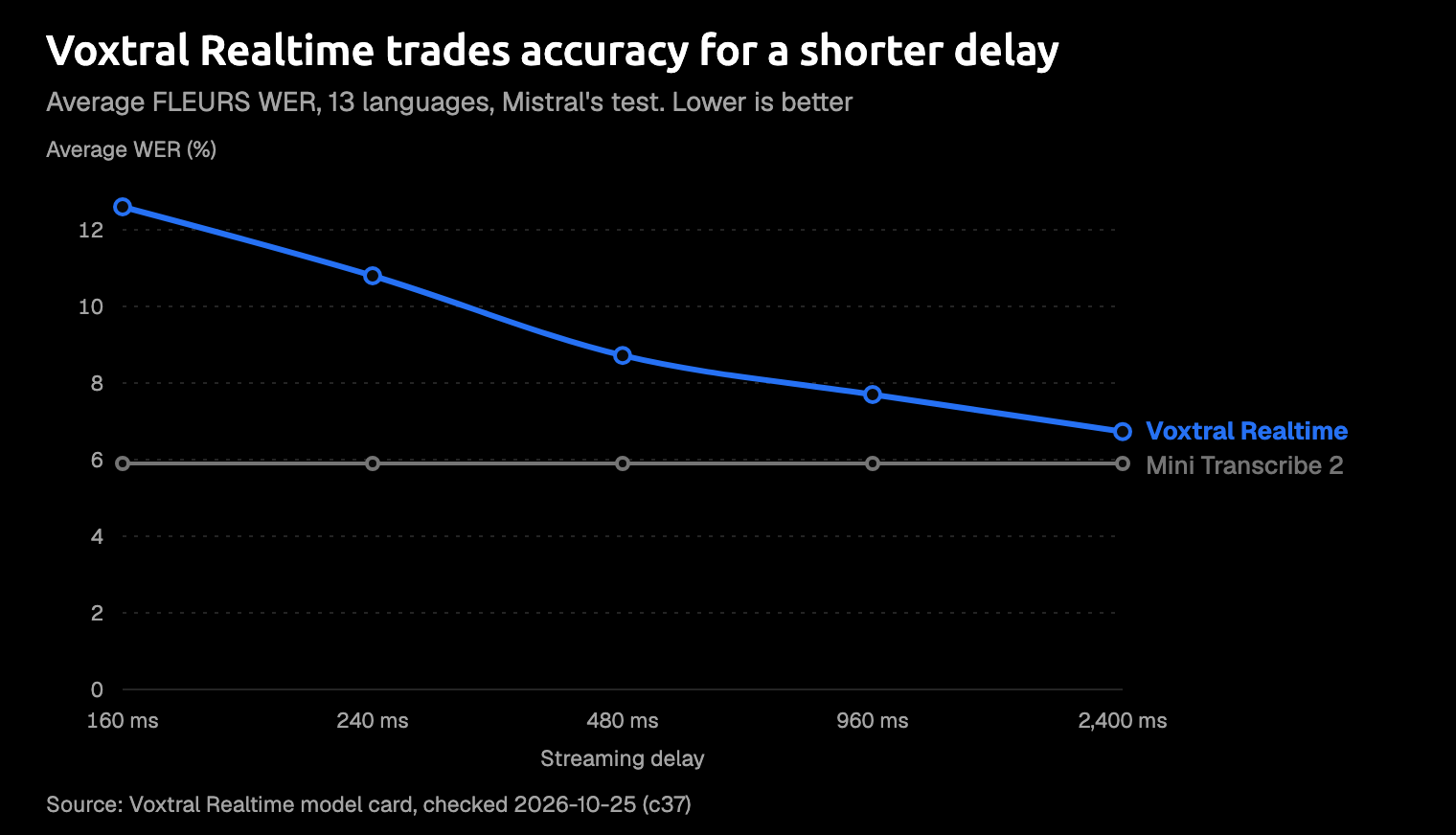
Mistral's FLEURS averages for Voxtral Realtime by delay, from its model card. A longer delay buys back accuracy.
Voxtral 3's chart. Mistral reports that Voxtral Small Transcribe 3 outperforms Whisper on its own 45-language FLEURS chart, but the page gives no numbers in text.
Speed and the streaming question
Whisper computes faster, and Voxtral Realtime shows you words sooner. Those are different kinds of fast.
RTFx measures how many seconds of audio a model gets through per second of compute, so higher is faster. Whisper Large v3 Turbo leads the cards: 200.19 seconds of audio per second of compute, against 54.09 for Voxtral Small 24B. Large v3, Mini 3B, and Realtime fall in between. Turbo's speed has a simple cause: it's Large v3 with 4 decoder layers instead of 32.
The bigger difference is how each one listens. Voxtral Realtime writes words while you're still talking, behind the delay you set. Mistral says that delay can go below 200 ms, and that Voxtral 3's realtime model runs under 500 ms. Whisper reads audio in 30-second windows, so it hands back text for a stretch of speech rather than word by word.
Our opinion, not a test result: for push-to-talk dictation, live words matter less than they seem. You hold a key, speak, and let go. While the key is down you're thinking about your next sentence, not reading your last one, so the wait you actually notice is the one after you let go.
Amical is built for that moment. You hold Fn on a Mac, talk, and release, and Amical pastes the text where your cursor is. By Amical's own figures, Amical Cloud has finished, formatted text ready in under 300 ms for short dictations and under 500 ms for longer ones. Mistral's 80 ms to 2.4 s measures how far live words trail your voice. Amical's figure measures the wait for finished text after you let go.
Streaming earns its place in long hands-free dictation and live captions. Amical has a hands-free mode too (Fn+Space), and Parakeet there still transcribes when you stop rather than as you speak. If watching words appear live is what you want, Voxtral Realtime is the one to try.
Can you run Voxtral on your laptop?
Officially, no. Voxtral Realtime's model card says it's supported only in vLLM, server software for running AI models on graphics cards, and it asks for a single GPU with 16 GB of memory or more. The vLLM recipe for the model doesn't mention Macs, Apple Silicon, or CPUs at all.
If you just went to check how much VRAM your MacBook has, that number won't tell you whether Realtime runs on it. The ports below will.
Unofficially, the community has been busy. Mistral's card lists several community ports and labels them untested. As of October 2026, the main ones are these:
- MLX. MLX is Apple's framework for running models on Apple Silicon. A 4-bit MLX version of Realtime is 3.13 GB on disk and runs through mlx-audio, which lists Apple Silicon Macs as its requirement.
- transcribe.cpp. transcribe.cpp is an MIT-licensed engine from the handy-computer organisation on GitHub, with Metal, Vulkan, CUDA, and CPU backends. Its Voxtral Realtime GGUFs (GGUF is a single-file model format) run from 2.83 GB, compressed, to 8.87 GB at full BF16 precision.
- audio.cpp. Mistral's own experimental account publishes GGUFs for it, with builds for Linux, Windows, and macOS. The card calls the framework young and notes that streaming lag doesn't recover during pauses.
- llama.cpp. Not supported. A pull request for Realtime closed unmerged in March 2026, and the planning issue closed as not planned in July.
Whisper is the opposite experience. In Amical, Whisper models run from about 78 MB for Tiny to about 3.1 GB for Large v3, on Mac and Windows, and you download one inside the app instead of building anything.
Voxtral on a laptop is a weekend project. Whisper is a download.
There are limits on the Mac side. Local Whisper needs macOS 15 or later and is slower on Intel Macs. Parakeet runs on macOS 14 and on Intel Macs, and Amical Cloud has neither limit.
If you're curious about Realtime, MLX or transcribe.cpp is the way to try it. On the Amical side, Local AI models lists the local options, and Whisper Large v3 Turbo vs Large v3 helps you pick a size.
Privacy: open weights vs hosted APIs
Open weights give you something no API can: run the model yourself, and the audio stays on your machine.
Mistral's hosted APIs work the other way. With Mini Transcribe 2 or Voxtral 3 through Mistral's API, your audio goes to Mistral and you pay by the minute. The way around that is self-deployment: Mistral's sales team arranges Voxtral 3 on a company's own infrastructure, and the Transcribe 2 launch post mentions on-premise and private-cloud setups.
Mistral's per-minute prices come from its February and October 2026 launch posts, so check them before you rely on them.
| Model | Price per minute | Launched |
|---|---|---|
| Voxtral Mini Transcribe 2 | $0.003 | February 2026 |
| Voxtral Realtime (API) | $0.006 | February 2026 |
| Voxtral Mini Transcribe 3 | $0.0035 | October 2026 |
| Voxtral Small Transcribe 3 | $0.0040 | October 2026 |
| Voxtral Mini Transcribe Realtime 3 | $0.008 | October 2026 |
Any hosted service, Amical Cloud included, comes down to two questions: where is the audio processed, and is it kept? Voxtral 3's API answers "in the EU" to the first and lets customers decide the second.
Amical's answer depends on the mode, and you choose it. In local mode there's no account, no audio leaves your computer, and text leaves only if you pick a cloud provider for formatting. To keep formatting on your computer too, point Amical at a language model running locally, through Ollama or any OpenAI-compatible endpoint. With Amical Cloud, your audio goes to Amical along with context for formatting, such as the app name and the text near your cursor. The pricing page states no data retention and no training on your data.
Knowing the mode tells you where your voice goes, which beats reading privacy pages at midnight. Cloud vs local dictation covers the trade-off in full, and Cloud AI models explains the cloud side.
Languages
Among the models in this post, Whisper has the widest open coverage, at 99 languages. The July 2025 Voxtral models cover 8, without Japanese, and Realtime covers 13, Japanese included. Voxtral 3's batch models reach over 50, but only through Mistral's API or a sales deal.
In Amical's local mode, you get Whisper's 99 languages, one language per dictation. Amical Cloud covers 100+ and handles Japanese and English in the same sentence, on the phone apps too.
So if your Slack messages start in Japanese and finish in English, Amical Cloud is the mode for you.
Multi-language support shows how to set your languages, and our Qwen3-ASR vs Whisper comparison looks at another challenger.
Which should you use for dictation?
Pick the app first and the model second. A model hands you text. A dictation app gives you a hotkey, puts the text where your cursor is, and shapes it for the app you're in.
- Private dictation on the laptop you have: Whisper or Parakeet v3 in Amical's local mode. Large v3 Turbo gives up a little English accuracy for speed: 7.83 on the leaderboard against 7.44 for Large v3, and an RTFx of 200.19 against 145.51. In Amical it's also half the download, about 1.5 GB against 3.1 GB. On an older or Intel Mac, start with Parakeet. Parakeet vs Whisper compares the two.
- Finished text fast, on your phone, or in 100+ languages: Amical Cloud. It needs sign-in, and it's what the iPhone, iPad, and Android apps use for transcription.
- Streaming, with a 16 GB GPU or a taste for tinkering: Voxtral Realtime through vLLM, MLX, or transcribe.cpp.
- An app built on an EU-hosted API: Voxtral 3.
- Linux: Amical has no Linux version, so Voxtral Realtime through vLLM, or audio.cpp with its Linux builds, fits you better.
In either mode, Amical's AI formatting rewrites your words for the app you're in: a proper email in Gmail, a loose reply in Slack, and a clean prompt in your code editor. That's the part no model card covers.
You came for a model. You're leaving with a workflow, and our roundup of speech recognition models covers the wider field.
Try it in Amical
The quickest way to settle any of this is your own voice in your own apps.
- Download Amical and install it. The desktop quick start walks you through setup.
- Choose a Whisper or Parakeet model to dictate on your own computer, or sign in to use Amical Cloud.
- Click into a real Slack reply or prompt you'd otherwise type, hold
Fn, and say it. - Let go, read what Amical wrote, and send it.
The free plan covers both modes: unlimited local dictation plus 2,000 Amical Cloud words a week, and local use never eats into those cloud words. The pricing page has the details. If Voxtral earns a place in your setup later, you'll know exactly what it has to beat.